SEO cost in Australia ranges from a few hundred dollars a month to many thousands. Quotes from opposite ends of that range can list almost the same things: a set number of blogs, some backlinks and a monthly report. The price tag tells you very little. What separates good SEO from cheap SEO is whether anyone’s making decisions about your business, or just working through a checklist.
Below is what small, medium and large budgets should buy you, and when it’s worth fixing your website first.
Content Overview
Why SEO quotes are all over the place
Most SEO proposals are built from the same parts: a keyword list, a technical audit, some blog posts a month, some backlinks and a report. Change the quantities and that package can cost almost anything. That’s how one agency can quote a few hundred dollars and another a few thousand for what looks like the same work.
Ten backlinks from sites nobody reads won’t help a plumber in Midland. Ten blog posts that repeat what every competitor has published won’t get a law firm noticed either. What you’re paying for is judgement: which searches are worth winning, what has to change on your site and what to leave alone.
That’s also how the price should be set. It should follow how hard your market is to win, not how big your business is. In a niche that isn’t very competitive, you shouldn’t pay what a business fighting national brands pays, and we don’t charge it.
What cheap SEO usually buys
At the low end, you’re mostly paying for a few hours a month. That usually means a generalist looking after a lot of accounts. They work through the same tasks for each one: tidy some page titles, run a technical scan, build a few links and send the report.
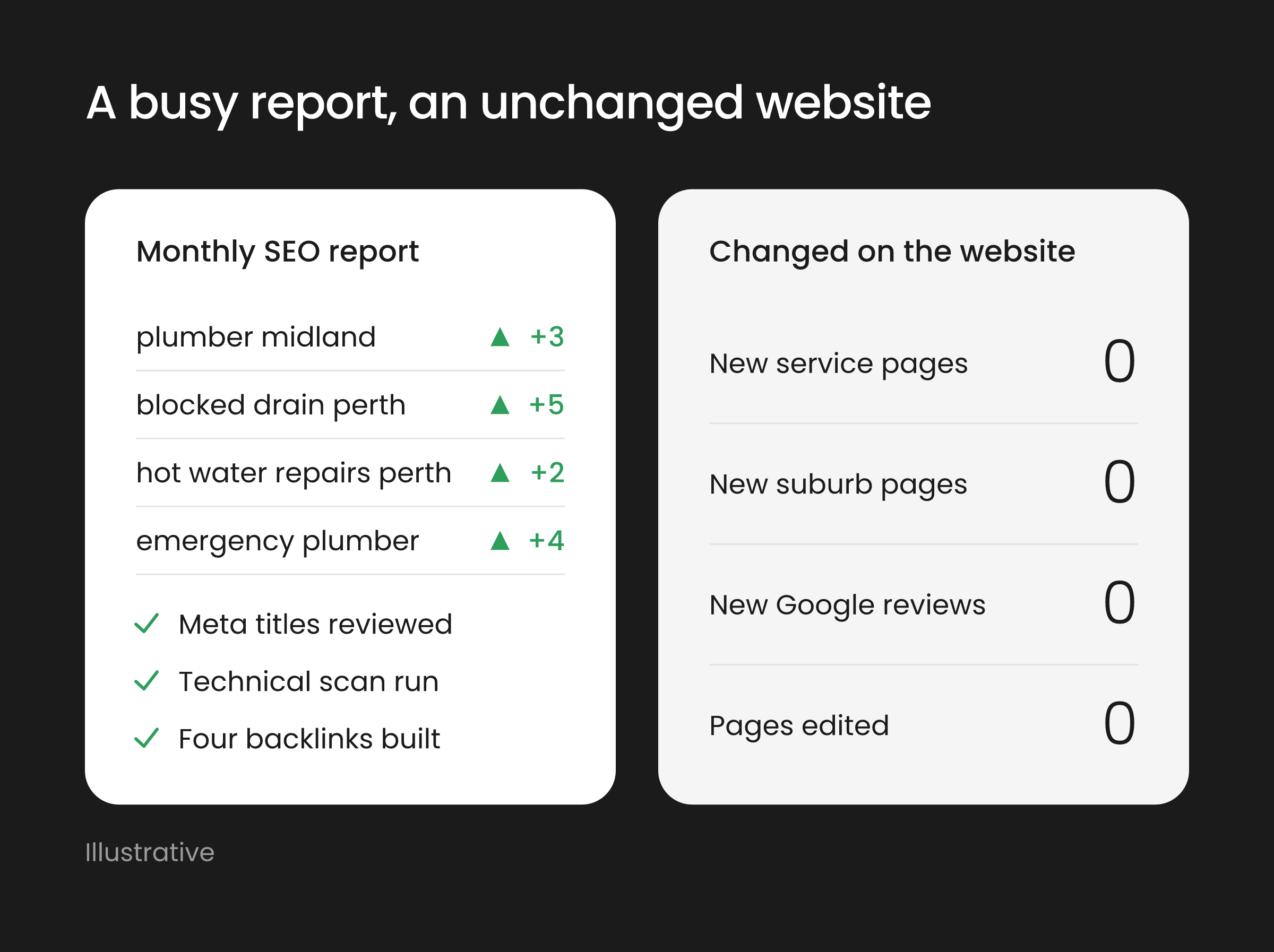
Picture a plumber paying $500 a month for SEO. The monthly report has keywords, green arrows and plenty of jargon, but nothing about pages being changed, problems fixed or reputation built. Meanwhile the website is a single page with no service pages, no location pages and no Google Business Profile. No amount of technical tidying will get a site like that onto page one, because there’s nothing on it for Google to trust.
None of those tasks are wrong. They’re back-end ticks, and on their own they make a small difference. What’s missing is anyone stepping back to ask what the business needs to win. For the plumber, that’s a website with real pages and a Google profile with reviews. It’s a one-off job, and often cheaper than a few more months of reports.
A small budget can still be the right budget. If your market is small and your site has obvious gaps, a few months of basic work beats a big retainer. Just make sure you’re paying for changes to your site, not a report about it.
How SEO cost should follow your market
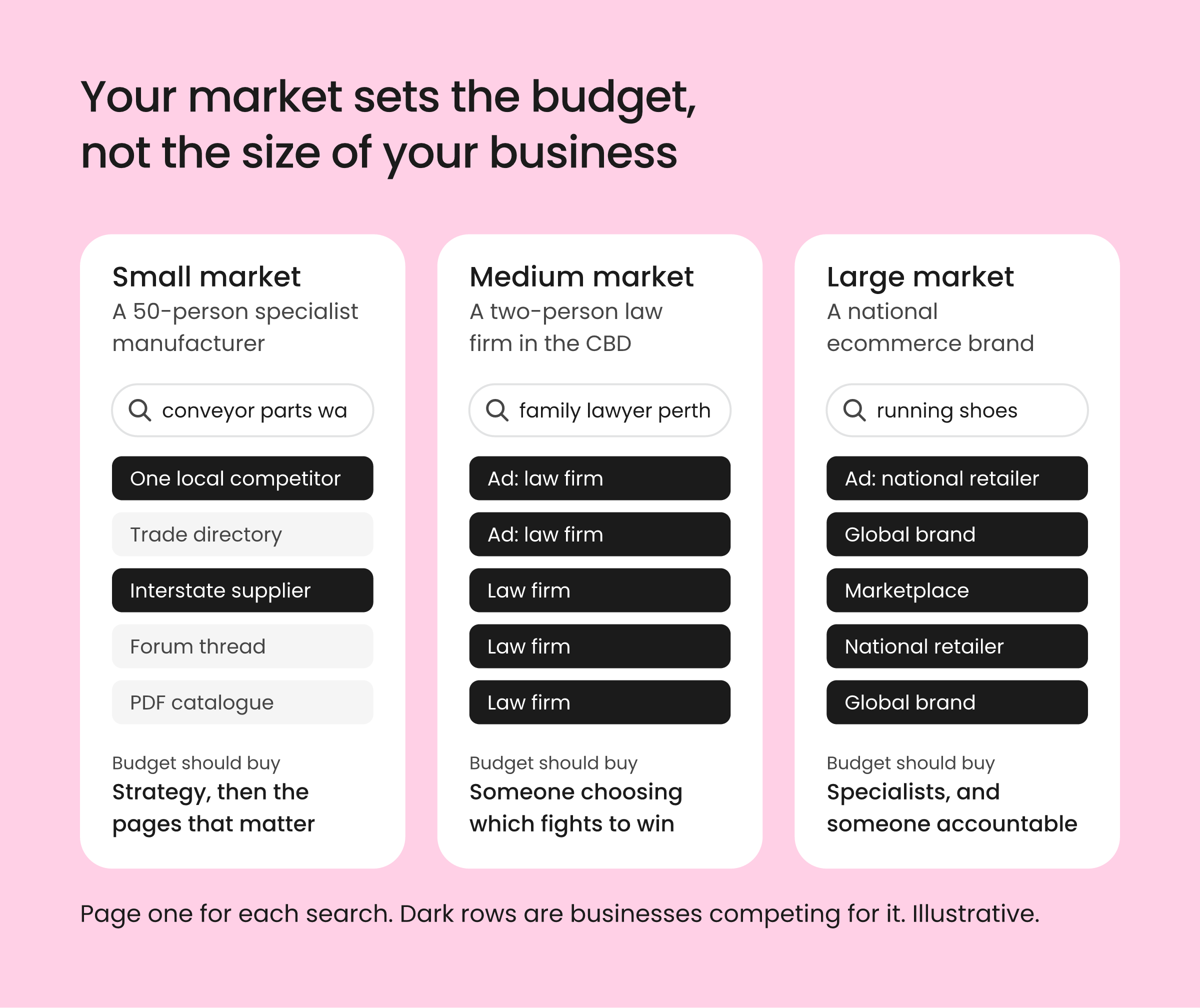
We don’t sell SEO in fixed packages, but most of the businesses we work with sit in roughly one of three places. Where you sit depends mostly on the market you’re competing in.
Small: a niche or local market
Think of a specialist B2B supplier with a few dozen competitors nationally, or a tradie who only works in a handful of suburbs. Not many people search for what you do, and not many businesses are trying hard to rank for it.
A small budget here should buy you a proper strategy up front, then steady work on the pages that matter. That means a page for each service and each area you work in, plus a complete Google Business Profile that keeps getting reviews. Add a few pieces of content that answer what your customers ask. This is mostly local SEO and website basics, and every change should be listed in your report.
Medium: a competitive city market
A Perth law firm, dental practice or home builder is up against dozens of businesses chasing the same searches. Some of them have been doing SEO for years. A medium budget should buy you someone who decides which of those fights you can win this year and which to leave for later. It should also cover enough hours to build the content and links that win them.
Content at this level has to say things your competitors can’t, because the generic version of every page already exists on their sites.
Large: a crowded national market
An ecommerce brand selling nationally, or a business with thousands of pages, is competing with big brands and big in-house teams. A large budget should buy you specialists across technical SEO, content and digital PR. It should also buy regular meetings with your decision makers, and someone accountable when traffic drops. A good test at this end of the scale: if losing a third of your organic traffic would seriously hurt the business, the budget should reflect that.
If a business in a small market is being quoted a large-market price, ask what the extra money buys. Sometimes there’s a good answer, but often it’s more blog posts and more links than the market needs. If you’re not sure which of the three you’re in, an SEO strategy should answer that before anyone talks about blog numbers.
What you should be paying for at any size
Whatever the budget, SEO should feel like a strategy conversation, not a menu of backlinks and blog posts. The first job is working out which markets you should be competing in at all. They need to match who you are, what you can spend now and later, and what the rest of your marketing is doing. A business running Google Ads on its top three services needs a different SEO plan from one that lives on referrals.
That takes time with the business. Someone has to sit down with you and pull out the things only you know. Think of the questions customers ask before they buy, and the jobs you’ve done that nobody else has. Think of the opinions you’d defend, and the reason people pick you over the business down the road. SEO people call this information gain: what your pages add that nobody else’s can. It’s brand work as much as SEO, and our brand strategy team spends a lot of its time on exactly this.
It’s also what gets you shortlisted in AI search. Google’s guidance on creating helpful content asks whether a page provides “substantial additional value and originality”. In our own testing of which pages AI cites, the answers lean on pages that say something specific and back it up. If your pages say what every competitor’s pages say, there’s no reason for you to be the business that gets mentioned.
Cheap SEO skips all of this because there’s no time for it in a few hours a month. The main thing a bigger budget should buy you is time spent understanding your business before anyone writes a word.
When to fix your website first
If your website doesn’t have pages for what you sell, or it’s a site you’d rather not send people to, start with the website. SEO on a site that can’t convert means paying to bring people somewhere they’ll leave, so it makes sense to fix that first.
It also helps to know what to expect on timing. SEO can take a few months to build real momentum (we’ve written about how long SEO takes), so if you need enquiries this month, it works well alongside something that brings in leads now. If you’re working out where a first marketing budget should go, our guide to spending your first $5k a month on marketing covers that.
What to ask before you sign
Google publishes its own list of questions to ask before hiring an SEO, in its guide Do you need an SEO?, and they’re good ones. These are the ones I’d ask any agency, including us, with one of my own at the top:
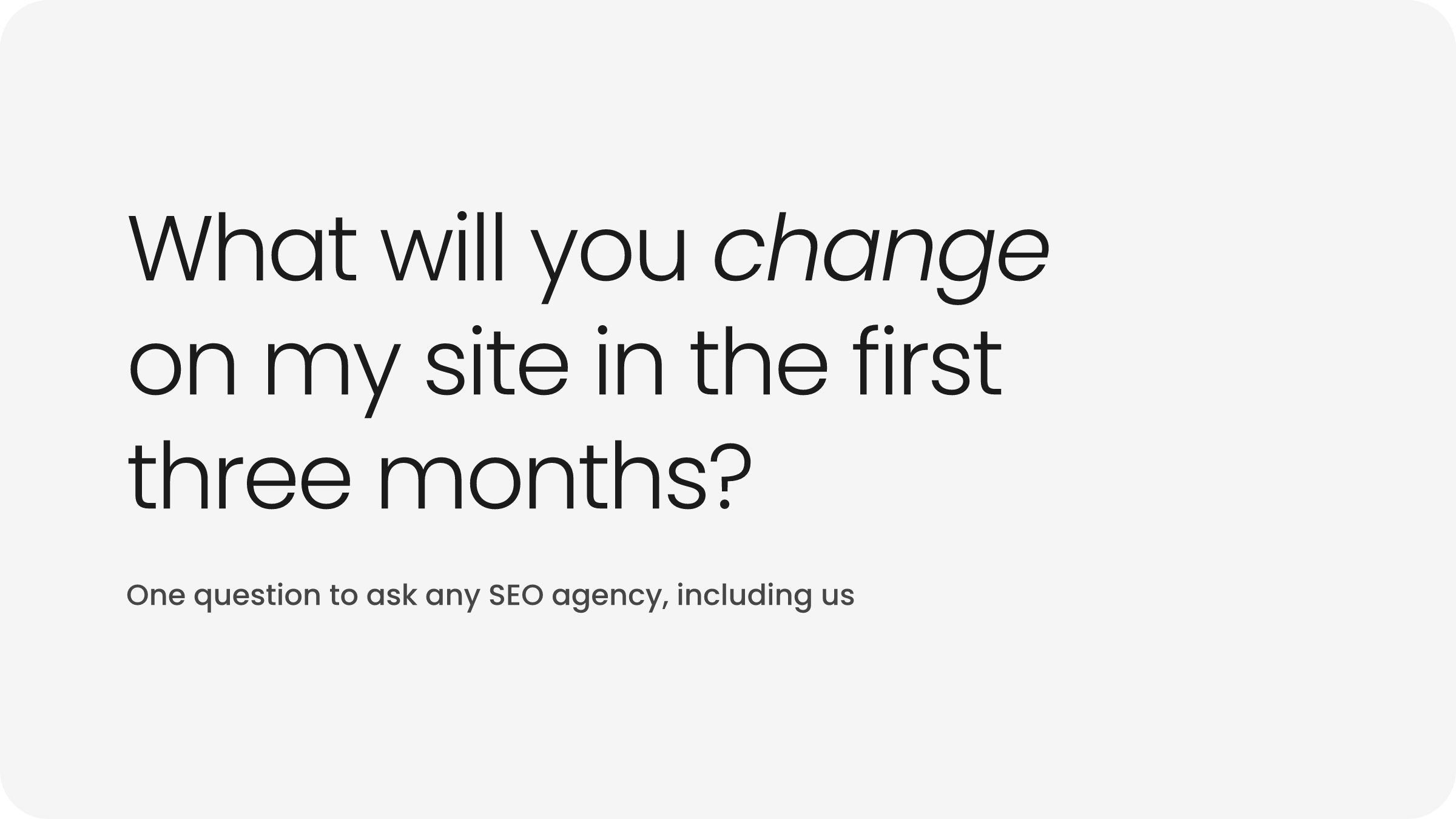
- What will you change on my site in the first three months?
- “What kind of results do you expect to see, and in what timeframe? How do you measure your success?”
- “Will you share with me all the changes you make to my site?”
- “Can you show me examples of your previous work and share some success stories?”
Be wary of anyone promising first place. As Google’s guide puts it, “No one can guarantee a #1 ranking on Google.”
SEO cost in Australia should come down to the market you’re in and the work it takes to win it. Whatever you spend, you should be paying for someone who understands your business, decides what’s worth chasing and changes your site to get there. If you’d like to know which of the three markets you’re in and what it would take, let’s talk. If your website needs work first, we’ll tell you that too.
How this post was made
This started with a video in which Harry Sanders, founder of StudioHawk, compared $500 and $5,000 SEO budgets. We tested his points against the SEO reports and websites Perth businesses show us. AI pulled the transcript, summarised it and helped write a first draft from Jack Headford’s notes on how we price and run SEO. I edited it and made the final call. The advice was checked against Google’s own guidance on hiring an SEO and on helpful content. Written and signed off by Ryan Wilson.

Ryan Wilson
Marketing Team Lead