
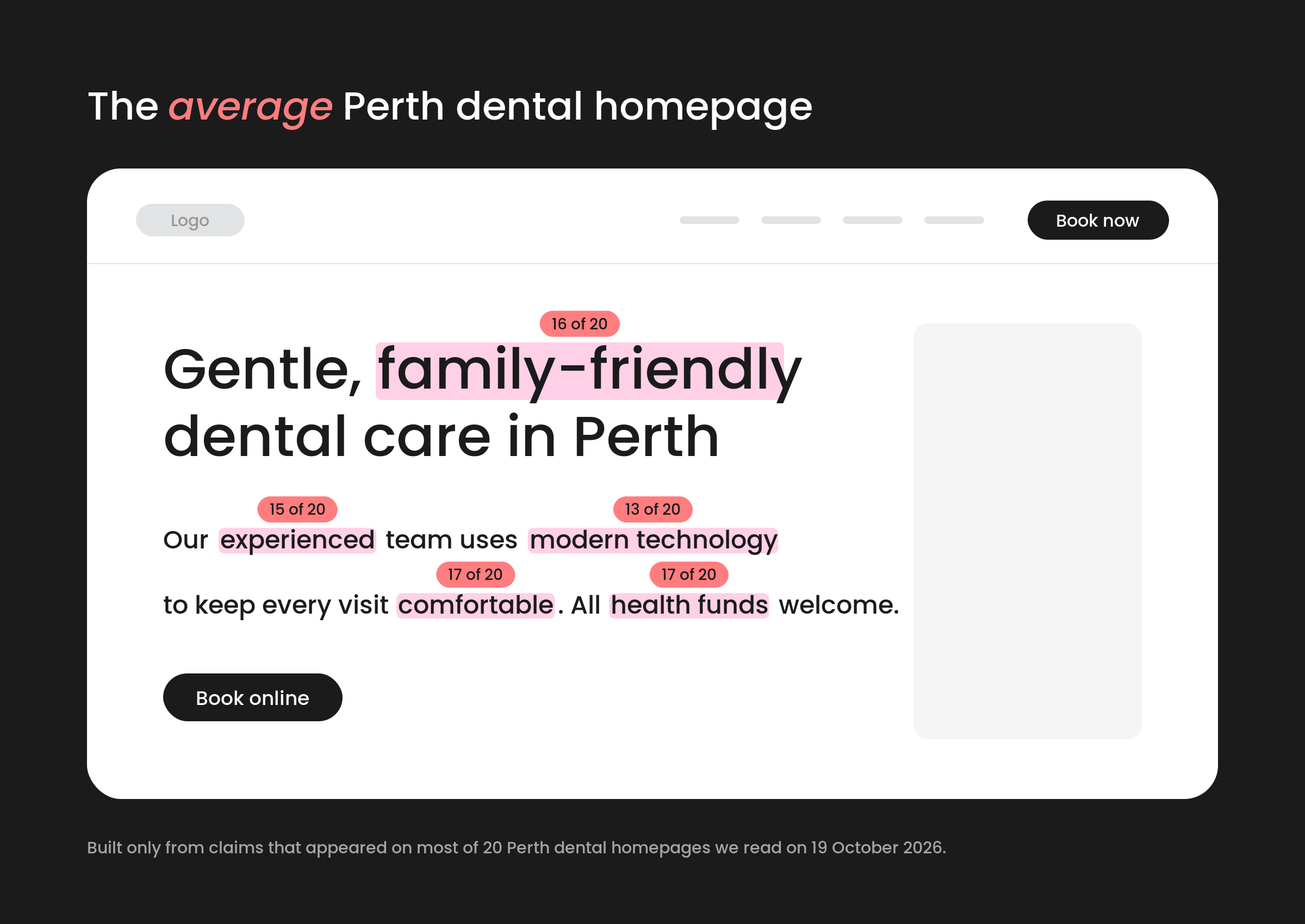
We went through the homepages of 20 independent Perth dental practices this month, and most of them could swap headlines without anyone noticing. Seventeen promise a comfortable visit, sixteen talk about families and fifteen tell you their team is experienced.
AI writing tools are about to make that sameness worse, right as AI search starts rewarding the opposite, something the SEO world calls information gain. Below is what we found, why it happens and what I’d do about it.
Content Overview
What 20 Perth dental homepages have in common
We picked 20 practices across the metro area, from Joondalup to Rockingham and Kalamunda to Cottesloe, and left out the national chains running one template across hundreds of sites. On 19 October we went through each homepage and counted how often the same claims turned up.
- Comfort: 17 of 20 promise a comfortable or relaxed visit.
- Health funds: 17 mention health funds, HICAPS or gap-free check-ups.
- Family: 16 describe themselves as family or family-friendly dentists.
- Experience: 15 say their team is experienced.
- Technology: 13 mention modern or advanced technology, and 11 use the word “gentle”.
The headlines follow the same pattern. Thirteen of the 20 lead with either the practice name (“Welcome to…”) or a suburb-plus-dentist line written for Google, and almost every main button asks you to book or make an appointment. Ten homepages give a specific proof point, and nine of those ten are the number of years the practice has been open. None of the 20 describes a single patient outcome.
None of those claims are wrong. Comfort, families and health funds are what people want from a dentist, so of course they’re on the page, but when every competitor says them they stop doing any work. A patient comparing three tabs ends up choosing on location or on whoever has the most reviews.
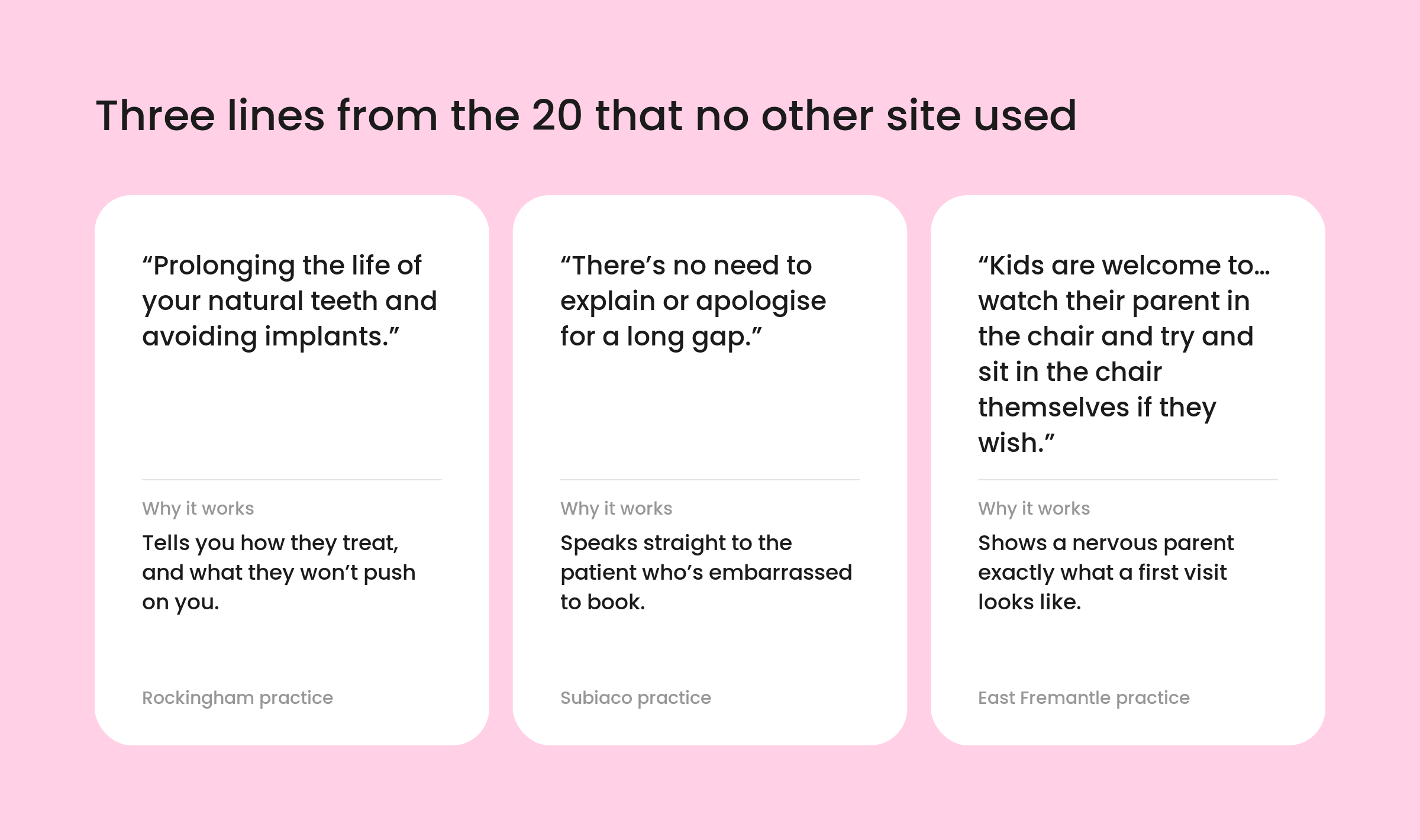
A few sites did say something nobody else did. A Rockingham practice says its treatment is aimed at “prolonging the life of your natural teeth and avoiding implants”. A Subiaco practice tells patients who’ve stayed away for years: “There’s no need to explain or apologise for a long gap.” An East Fremantle practice invites kids to watch their parent in the chair and try sitting in it themselves. Each of those tells you something about how the practice works, which a list of adjectives can’t.
We asked Google’s AI Mode to write one
Then we gave Google’s AI Mode the most ordinary brief we could think of: write the homepage headline and opening paragraph for a dental practice in Perth. This is what came back on 19 October 2026.
“Modern Dental Care in the Heart of Perth — Gentle, Personal, and Built for Your Smile
Welcome to your local Perth dental studio, where contemporary technology meets a warm, patient-first approach. Whether you’re looking for routine preventative care, restorative solutions, or a confidence-boosting smile makeover, our experienced team provides tailored treatments in a calm, relaxed environment.
We’re dedicated to keeping Perth smiling brightly with transparent, high-standard dentistry designed around your unique needs.”
It used four of the six claims we counted in the audit: modern, gentle, experienced and relaxed. It could sit on most of the 20 sites we read without anyone noticing.
The AI did exactly what it’s built to do. Google’s own guidance on generative AI content explains that generative models “don’t retrieve facts, but predict a likely sequence of words” from what they were trained on, so their default is the safest, most predictable answer. Ask for a dental homepage and you get the most typical one.
Your customers need a reason to choose you
From the customer’s side, a website has one job before anything else: help them decide you’re the one to call. “Gentle, experienced and family-friendly” can’t do that when the next two practices say it too, because it describes every practice in the category.
A reason to choose is something specific a competitor couldn’t copy without changing how they work. It might be a treatment philosophy, a type of patient you’re set up for, a promise about what happens when someone’s anxious, or a thing you refuse to do.
We’ve written before about how a good position is often something you refuse to do, and the Rockingham practice’s line of: “prolonging the life of your natural teeth and avoiding implants” is a neat example of that in the wild.
If you’re not sure what your reason is, that’s a brand strategy question to answer before anyone rewrites a word of your website, whether that’s a person or an AI tool.
Information gain: AI search needs something new from you
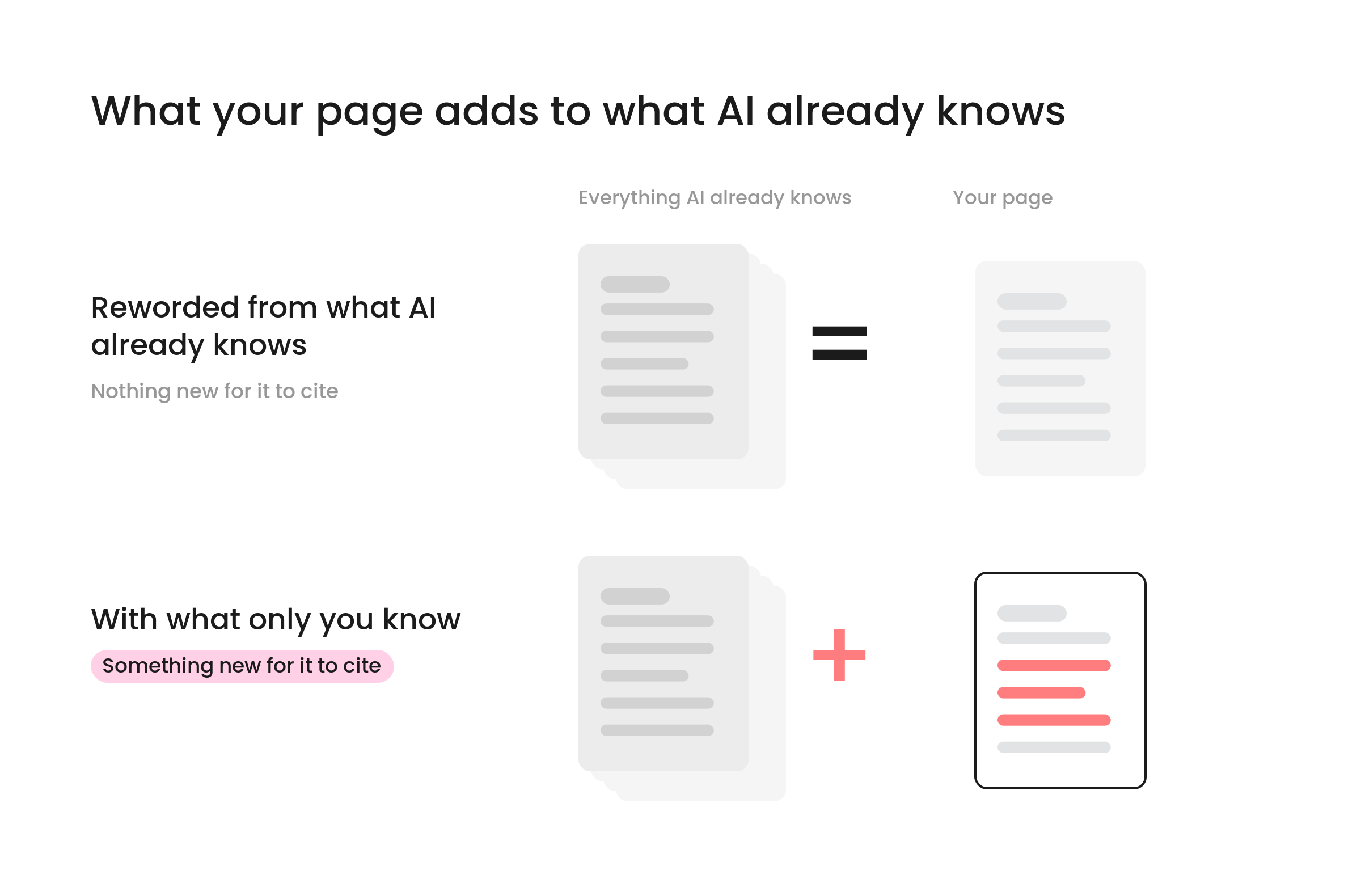
AI search has the same problem from the other direction. When Google builds an AI Overview or answers in AI Mode, it pulls in pages from its index and writes a response from them. If your page says what the other 20 say, it adds nothing the answer doesn’t already have, so there’s no reason for it to be the one cited.
The SEO industry calls this information gain: what a page adds beyond what a reader, or an AI system, has already seen.
Google’s published guidance says much the same thing in plainer words. Its guide to its generative AI search features tells site owners: “Don’t just recycle what others on the internet have already said, or could easily be produced by a generative AI model.” It also notes that its AI systems “take a look at a variety of sources, so it can be helpful to have a unique viewpoint that stands out.”
Its page on creating helpful content asks whether content that draws on other sources provides “substantial additional value and originality”.
A homepage that reads like the average of its competitors fails all three tests, however well it’s written. Our post on which pages AI cites covers what tends to get picked up instead.
Why a better prompt won’t fix it
The obvious response is to write a better prompt when getting AI to help you, and a better prompt might get you better writing. What it can’t do is give the AI knowledge it doesn’t have. Your competitors have the same tools, the same models and, increasingly, the same prompt templates, so if everyone asks the same machine the same question, everyone gets roughly the same answer.
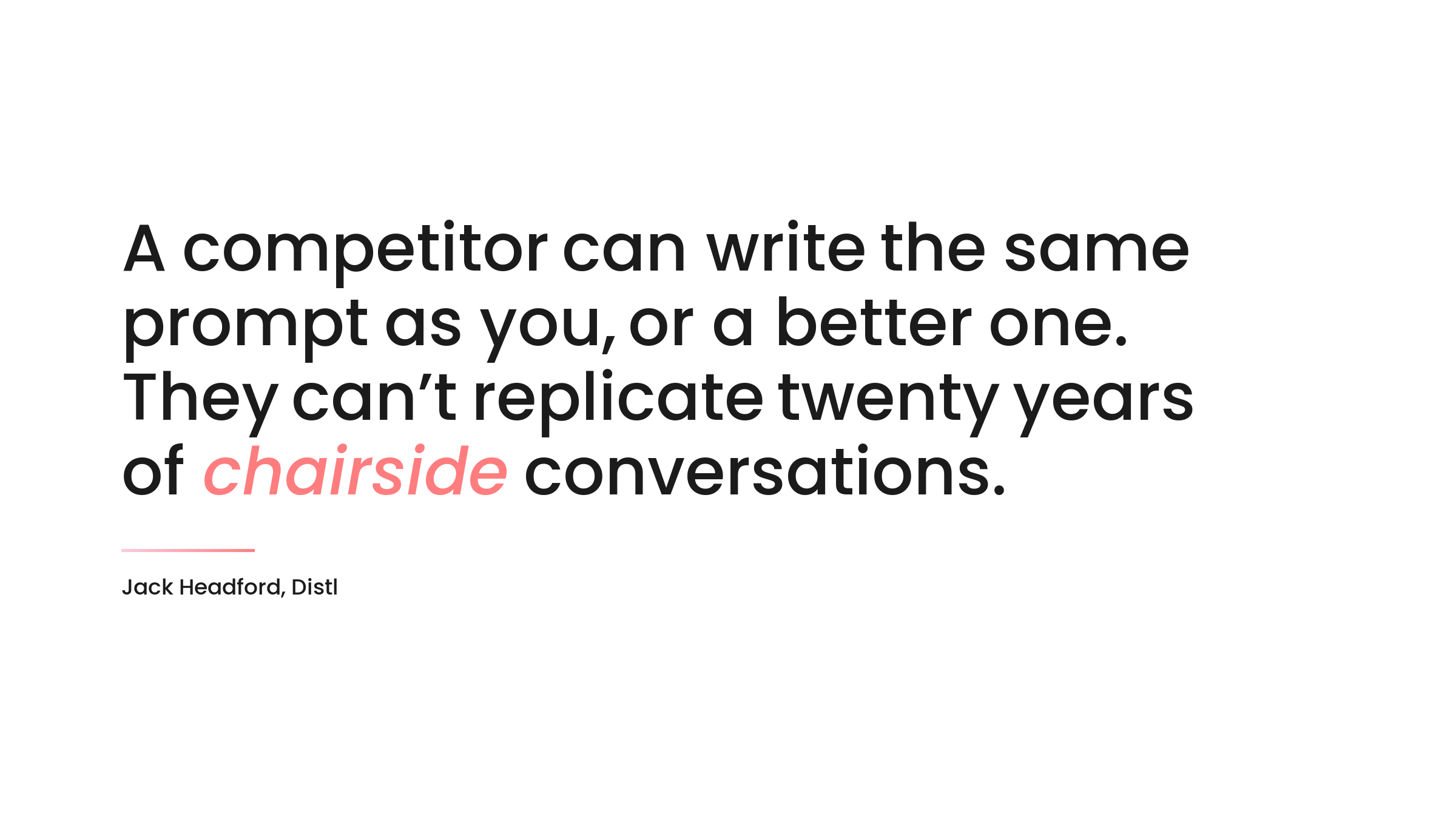
The difference has to come from what goes in, and the useful inputs are the ones only you have. For our dentists that would mean the jobs they’ve done, the questions your patients or customers ask every week, your numbers, and the calls you’d make that the practice down the road wouldn’t. A competitor can write the same prompt as you, or a better one. They can’t replicate twenty years of chairside conversations.
We use AI every day at Distl, for research, first drafts and pulling patterns out of data, and I’d never tell a business not to. The risk is using it without anyone critiquing what comes back, and without a clear idea of what makes the business different in the first place. Without both of those, AI gives you a safe, average version of yourself, and it’ll be very well written.
What I’d do instead
Say one thing your competitors can’t
Open your homepage next to your three nearest competitors and highlight every claim that appears on more than one. Whatever’s left is your starting point. If nothing’s left, work out the one thing you’d defend in front of a patient (or a client) before you change any copy, and put it in the headline.
Show the proof, not the adjectives
“Experienced” is a claim. “Our principal dentist has worked from the same chair since 2004” is proof, and so is a photo of your real team or a plain explanation of what happens, step by step, when a nervous patient walks in. On a recent episode of the Search With Candour podcast, SEO consultant Brendan Bennett put it well: when people search to check whether you’re legitimate, the answer is usually to show “how we’re accredited” rather than to add an FAQ that says you are. If you run a dental practice or another registered health service, Ahpra’s advertising guidelines put extra limits on things like testimonials and before-and-after photos, so check the latest guidance (and with your adviser) before you publish either.
Feed AI what you know
Give the AI your own material to work from: interview notes, real patient questions, your own data, a voice memo of how you’d explain a treatment. Then have a person who knows the business read every line before it goes live. Our guide to what AI is saying about your business is a good way to see how AI describes you now, and our GEO team works on what you can do about it.
The businesses that stand out in AI search over the next few years will be the ones that are easiest to tell apart, with something specific to say and the proof to back it up. That’s information gain in practice, and no prompt can supply it for you. If you’d like us to put your website next to your competitors’ and tell you plainly how different it looks, let’s talk.
How this post was made
The audit of 20 Perth dental homepages was set up by us: we chose the checklist, AI fetched the pages on 19 October 2026 and tallied the claims, and I checked a sample by hand and decided what was generic and what was worth quoting. We also gave Google’s AI Mode one plain prompt, and its unedited answer is in the post. AI helped summarise two podcast episodes and draft from my outline. The argument and the conclusions are mine. The facts were checked against Google’s own guidance on AI search and helpful content, the published Science Advances study and the patent record. Written and signed off by Jack Headford.

Jack Headford
Account Manager & Operations Lead