Ask how to rank in AI Overviews and most advice points to versus pages, the posts that put two options side by side. So we looked at which of our own pages Google’s AI cited from late March to late September. Our versus posts barely showed up. The page it cited most was our website cost guide, which answers a question plenty of businesses would rather not answer in public.
Here’s why the advice works where it came from, what our data showed, why our buyers differ, and how to check your own.
Content Overview
- Versus pages win when the buyer is comparing vendors
- What Google’s AI cites on our site, in order
- Our buyers ask a different question
- How to rank in AI Overviews: answer the question you’d rather not
- How to check which of your pages AI cites, and the traps
- Start with the question your clients are nervous to ask
Versus pages win when the buyer is comparing vendors
Much of the current advice traces back to Ross Hudgens of Siege Media. Siege’s study of B2B websites found versus pages were “the single strongest content predictor of AI search traffic”, meaning visits that arrive from AI assistants. Hudgens made the same point on Edward Sturm’s show in September: his clients with the most AI traffic overall had the most versus pages.
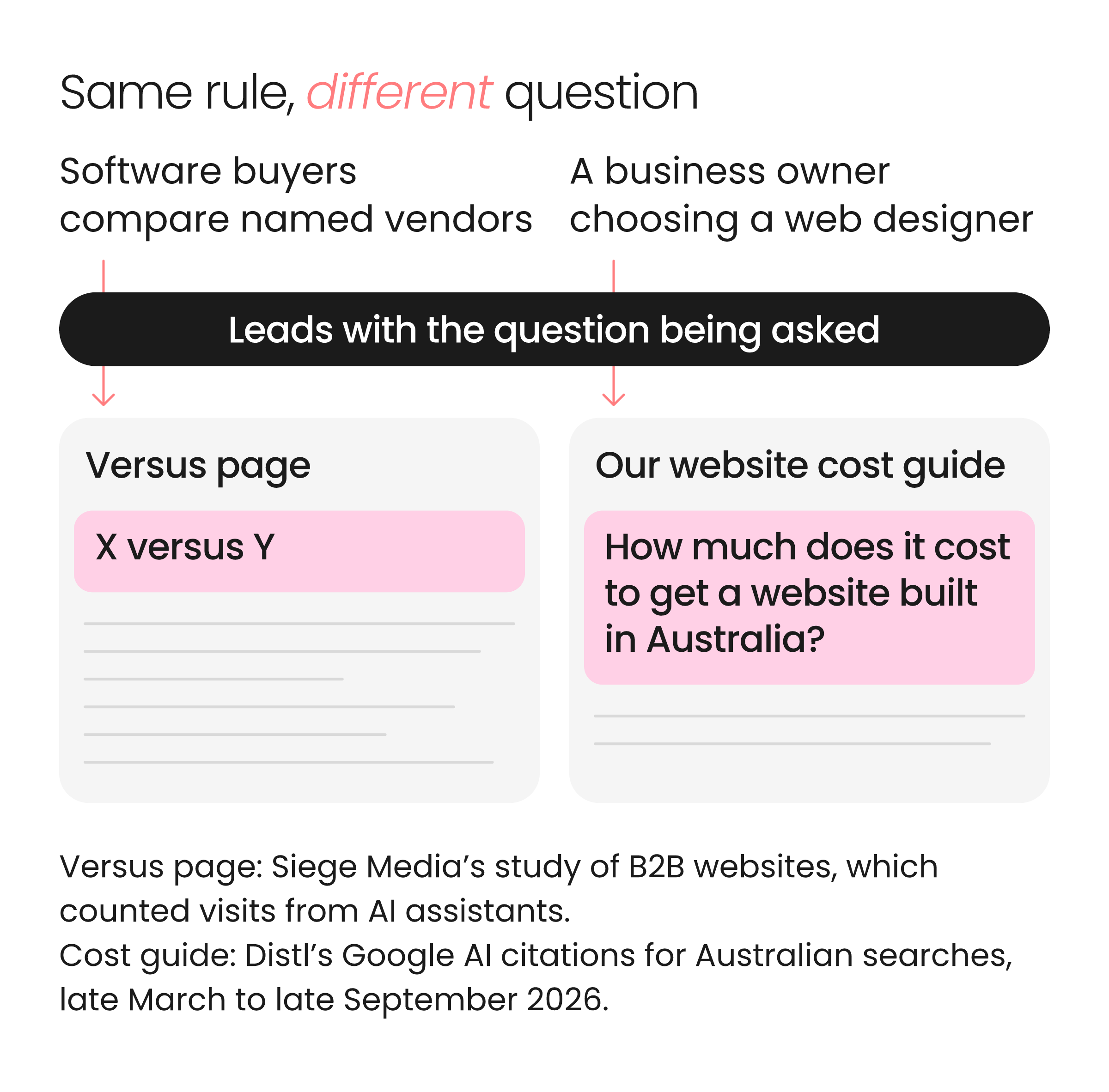
Siege puts it down to matching. When someone asks AI to compare two options, say X versus Y, it tends to cite pages that “match the question shape”. A versus page leads with the question being asked, so it hands AI a ready-made answer to quote. Siege is also upfront that content explains only part of the gap in AI traffic between B2B sites.
Hudgens thinks a versus page belongs on a landing page, and he picks the competitors to compare against from what comes up in sales calls. Clients are usually nervous to publish versus pages, few businesses enjoy naming a competitor on their own website.
For a software company whose buyers compare named products, that is good advice.
What Google’s AI cites on our site, in order
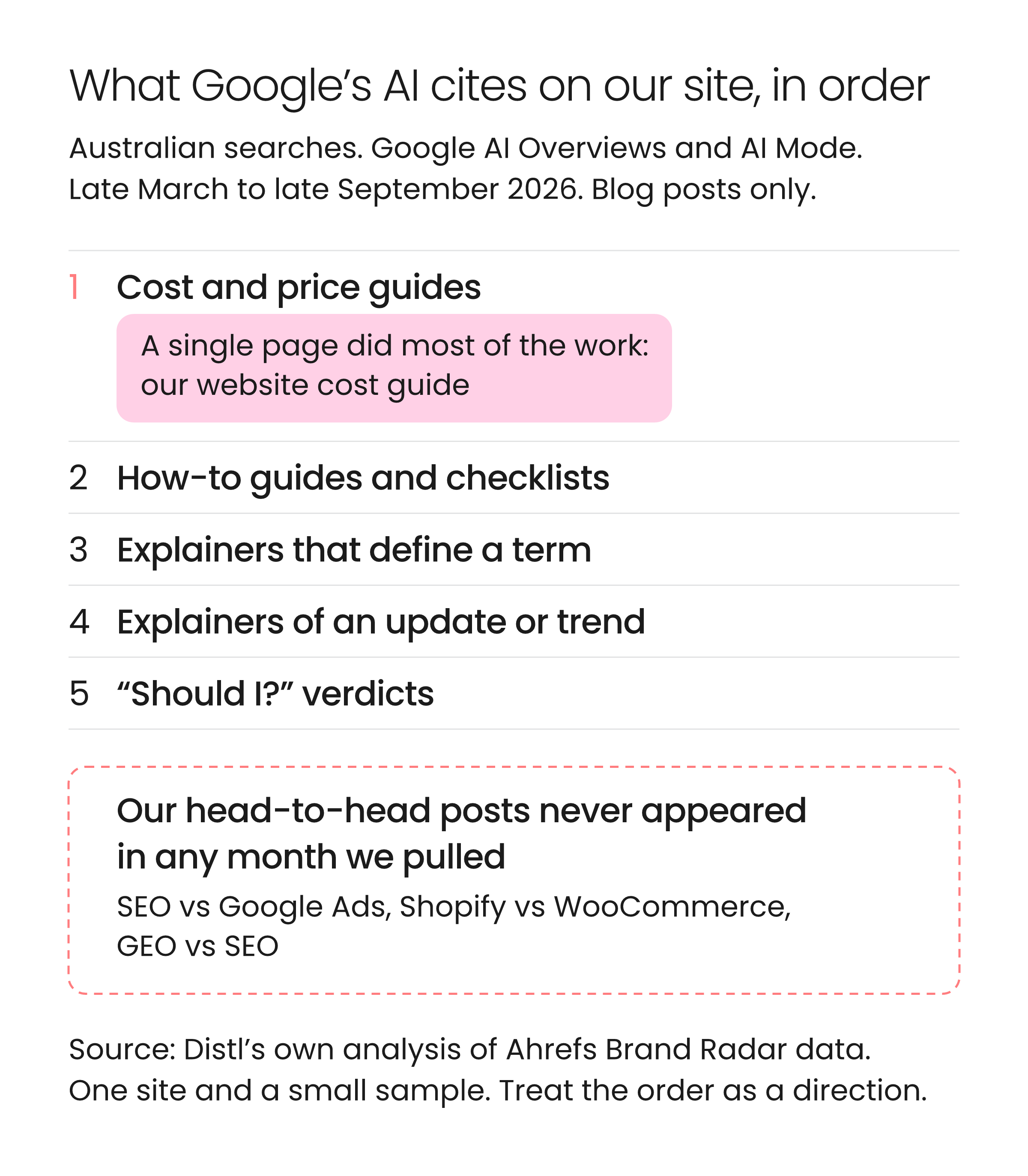
For Australian searches, the page Google’s AI cites most is our website cost guide, and nothing else on our blog comes close.
Ahrefs Brand Radar tracks which pages Google’s AI Overviews and AI Mode cite across a large set of searches. We pulled every Distl citation it recorded from late March to late September 2026. Then we sorted our blog posts by the question each one answers, and ranked the types by how many different Australian searches cited them.
- Cost and price guides. “How much does it cost to get a website built in Australia?” and “How much should I pay for a web designer?”
- How-to guides and checklists. “how to optimise google maps perth australia” and “seo audit checklist”
- Explainers that define a term. “what are backlinks” and “nofollow”
- Explainers of an update or trend. “google core update” and “Is SEO dead or evolving in 2026?”
- “Should I?” verdicts. “Can you run TikTok ads in Australia?” and “Can you use TikTok for business?”
A single page did most of the work in that top slot. Question after question about what a website costs, worded every which way, led back to the cost guide.
Versus posts didn’t make the five. The versus-style posts AI did pick up compare two concepts, like dofollow and nofollow links, and AI cited them for the definition. The one exception, our post on Pinterest and Meta ad costs, was cited when someone asked what Pinterest ads cost. Our head-to-head posts (SEO vs Google Ads, Shopify vs WooCommerce, GEO vs SEO) never appeared in any month we pulled.
The ranking covers blog posts only. Agency searches like “seo perth” go to our service pages instead, and questions about businesses we’ve worked with go to our case studies. It’s one site and a small sample, it’s Google’s AI only, and Ahrefs chooses the searches.
Our buyers ask a different question
Software buyers compare named vendors, so a versus page matches the question they’re asking. Most questions citing our blog were about money or doubt: what a website costs, what a web designer charges, whether SEO is dead. None of them asked AI to compare Distl with another agency.
Our read is that a business owner choosing a web designer rarely types “you versus them” into a search bar. They want to know what it’s going to cost, and who’s any good.
Wix studied AI answers across ChatGPT, Google AI Mode and Perplexity. As Search Engine Land reported, the intent behind a question predicted what got cited more than the industry or the AI model did. The same Wix research found comparison and alternatives pages make up a small slice of AI citations across every industry it covered.
If you sell software or a product people compare by name, and prospects keep asking “how do you compare to X?”, build the versus page. Put it on a landing page, the way Hudgens describes.
If you’re a local service business, your buyers rarely search “you versus them”, so start with the page that answers what it costs.
How to rank in AI Overviews: answer the question you’d rather not
The page at the top of our list answers a question plenty of service businesses avoid answering in public. It answers it early and plainly, and it stops short of giving away the whole back end.
Our cost guide opens with a quick overview of price ranges, right in the first screen. It then explains what pushes the cost of a website up or down, and what each stage of a build involves. The quote for your specific project stays for a conversation.
Your method, your rate card and the quote for a particular job are the back end, and they stay yours. The answer is the range and what moves it. Publish what’s true for anyone who asks, and keep what’s only true for one client’s job.
Ranking first in ordinary search isn’t the entry ticket. Our cost guide sits well down the ordinary Google results for the main cost searches, and AI cites it anyway. Google says AI Overviews and AI Mode can run several related searches behind one answer. That lets them show a wider set of links than a normal results page. You don’t need special markup, files or other optimisation to appear in either. That may be part of why a page well down the results still gets quoted, though our data can’t prove it.
Finding the question means listening to people rather than reading a keyword tool. It’s the one prospects ask just before they request a quote, the one your team hears every week. Hudgens picks versus competitors from what comes up in sales calls, and you can find the question you’d rather not answer the same way.
If you’re a service business nervous about publishing prices, publish ranges and what moves them. You keep the quote, and the person asking gets their answer from you instead of from someone else.
If you’d like a second pair of eyes on which questions your site should answer first, that’s part of our generative engine optimisation work.
How to check which of your pages AI cites, and the traps
Run the check on your own data, weighted for your own market, before you act on anyone’s advice about how to get cited by AI. That includes ours.
Ask the assistants your buyers’ questions. Use the words your clients use, set to your market, and note which of your pages get cited. We’ve written up how to check what AI says about your business step by step.
Look at Search Console. We’ve covered how to read Search Console’s AI performance report and turn what it shows into enquiries.
Weight it for your market. Our Google Ads post is cited in country after country and never in Australian results, so a worldwide total flatters us. If your buyers are local, filter by country before you read anything into the order.
Trap one: a single blended score. Hudgens argues that AI visibility trackers roll everything into one general score, which quietly discourages you from adding new questions to track. A single AI search visibility number also hides which topics you’re winning and losing, so track by topic.
Trap two: every assistant weighted the same. Hudgens suggests checking whether Perplexity shows up in your own data at all before a tracker gives it equal weight. In Australia, Optus offered eligible mobile customers a free year of Perplexity Pro from June 2025, so look before you write it off. Our own tracker weights Perplexity the same as ChatGPT, and Perplexity is where we look best. We take that score with a grain of salt.
The cheapest signal sits on your enquiry form. Ask “How did you hear about us?” as an open box people type their answer into.
If you’re a local service business, that one form field will tell you more than any AI visibility tool.
Start with the question your clients are nervous to ask
Versus pages are good advice for businesses whose buyers compare vendors by name. For most Australian service businesses, the first page worth building answers the question you’d rather not. Write down the questions you sidestep on sales calls, then answer the first one properly this month. Give the range, what moves it, and the point where your quote takes over.
If you’re working out how to rank in AI Overviews for the questions your buyers ask, that page is where we’d start. For help deciding which questions your site should answer first, talk to one of our team.

Ryan Wilson
Marketing Team Lead