
If your Google Ads bring in eight enquiries a month, most of the Google Ads advice for small business owners is terrible. The standard playbook says to let Google’s automated bidding learn from your conversions, and that works well when there are plenty of them to learn from.
It doesn’t matter whether you’re a plumber in Bunbury, a commercial fit-out company in Perth or a specialist with a $20,000 service. When the conversions aren’t there, the algorithm can’t be relied on to learn. Below is how we’d tell whether you’re in that spot, how we’d set the account up, and what we’d measure instead.
Content Overview
Low volume is about enquiries, not population
Low volume comes down to tracked enquiries per campaign each month, and population is only one way to end up there. A B2B company selling to a few hundred possible customers is low volume. So is a high-ticket service where one job is worth $30,000 but only a handful of people search for it each month. So is any account that’s just been set up and has no conversion history at all.
A rule of thumb you’ll hear a lot is around 30 conversions per campaign in 30 days before automated bidding settles down. Google doesn’t publish a hard minimum, so treat that figure as a practitioner’s guide. If your campaigns are well under it month after month, the advice below applies to you.
Why the standard playbook struggles
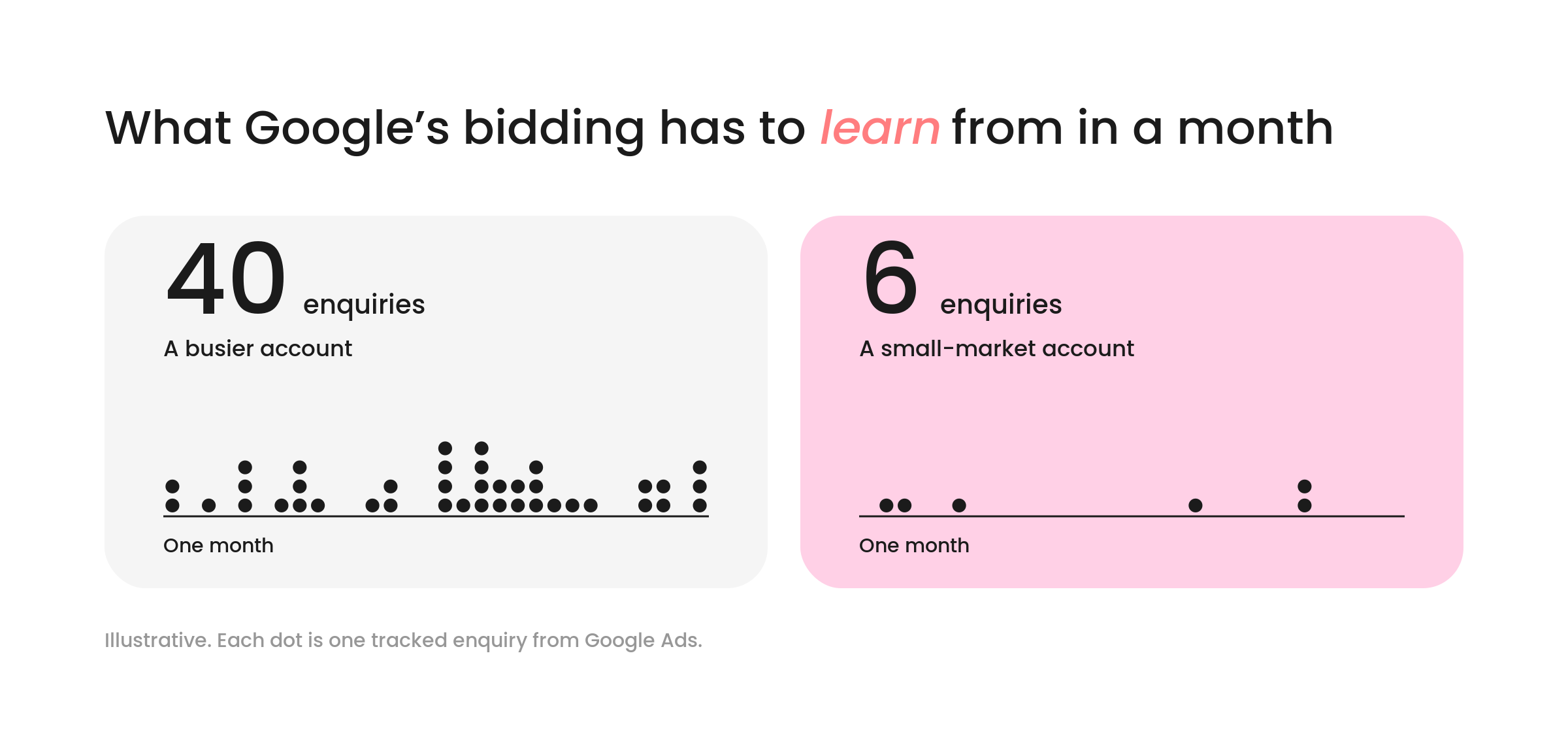
Google’s automated bid strategies set your bid for each auction based on how likely that search is to turn into a conversion. They learn that from your account’s history, if there’s enough volume to maintain 40 conversions a month there’s a pattern to learn from. With a handful, a couple of good or bad weeks can swing the whole thing, and you can end up paying for clicks that look promising to the algorithm and never call.
We covered what happens when target-based bidding does have enough data in Google Ads smart bidding now hits your target. This post is for the accounts that aren’t there yet.
Some of your best keywords may not even be eligible
In a small market, the most specific searches are often the ones you want most, like a service plus a regional town, or a niche product name. Google marks keywords with very little search history as “Low search volume“, and they stop triggering your ads until searches pick up. Raising the bid doesn’t change that status.
Check the Status column on your Keywords page. If your most important keywords are sitting at Low search volume, broaden the match type a little (phrase match is usually enough) or use a slightly more general version of the term, rather than adding a raft of loosely related keywords to make up the numbers.
How we’d set up Google Ads for a small business
Keep keywords tight and high intent
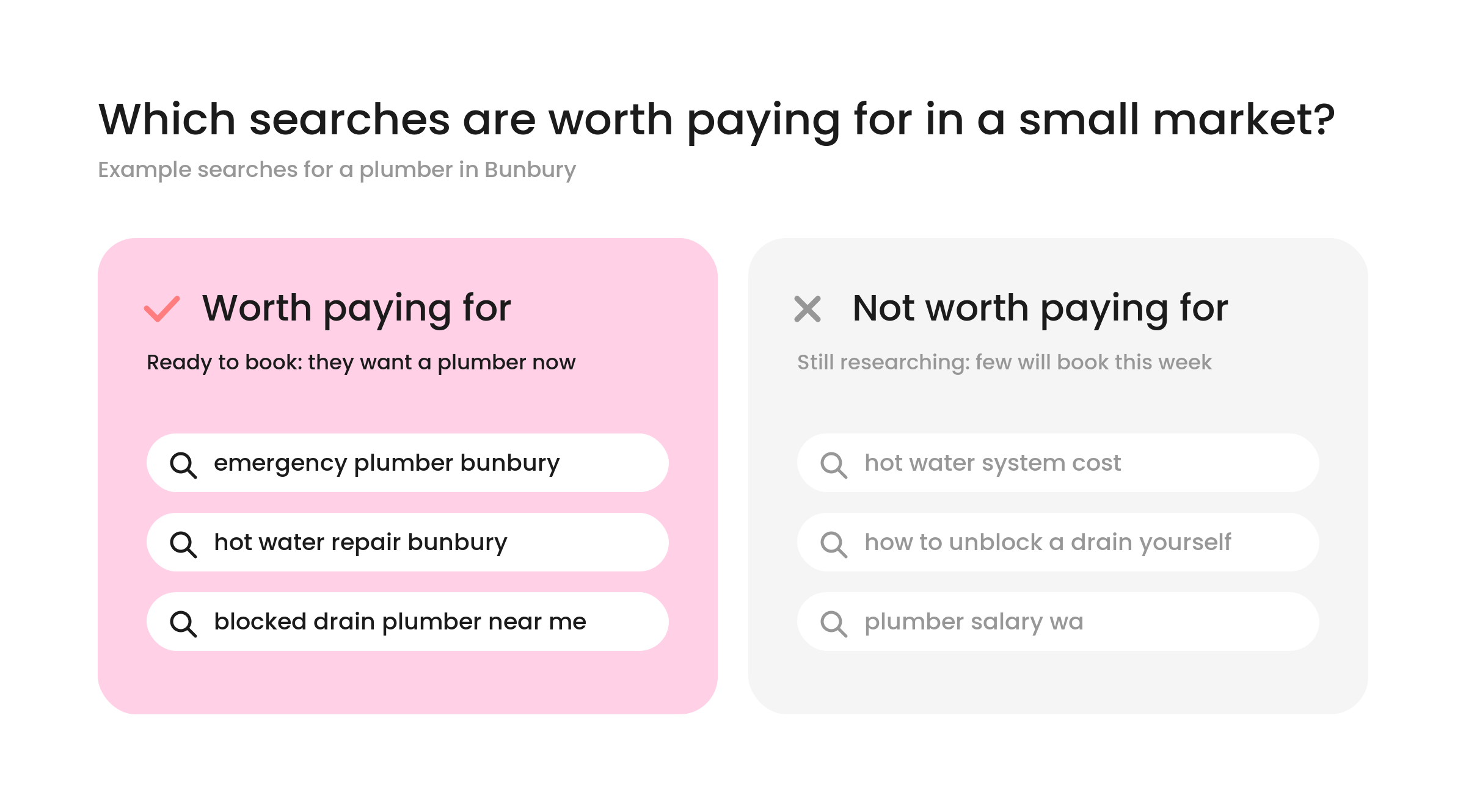
The most common mistake we see in small accounts is broadening into research-style searches to get more volume. “How much does a new hot water system cost” gets plenty of searches, but very few of those people are ready to book this week. Stick to the searches that signal someone wants to buy or book, and use negative keywords to keep the rest out.
It’s the same discipline that makes Google Ads for tradies work in any market.
Bid to be at the top, not to guess conversions
When only a few hundred people a month search for what you do, the job is to show up at the top for as many of them as you can afford. You can own a monopoly on the top ad spots for the most high intent keywords, as long as the cost per enquiry still makes sense.
Google has a bid strategy built for this. Target impression share sets your bids with the goal of showing your ad at the absolute top of the page, at the top, or anywhere on the page, for a share of searches you choose. Set a maximum cost per click as a cap, but not too low, because Google warns that a cap set too low stops the strategy reaching its goal. Manual bidding is the other option if you want full control and have someone checking the account every week.
Fix the page and the phone first
With so few clicks, every lost enquiry hurts. A landing page that loads slowly, buries the phone number or asks for too much in a form will waste a much bigger share of a small account than a large one. Our checklist for how Google scores your landing page is a good starting point.
Make sure calls from your ads and website are tracked too, because in a lot of regional businesses the phone is where most enquiries come in.
What to measure instead
The number most business owners never see is impression share: how often your ad showed up when someone searched for what you sell. Google also reports top impression share (shown above the organic results) and absolute top impression share (the very first ad).
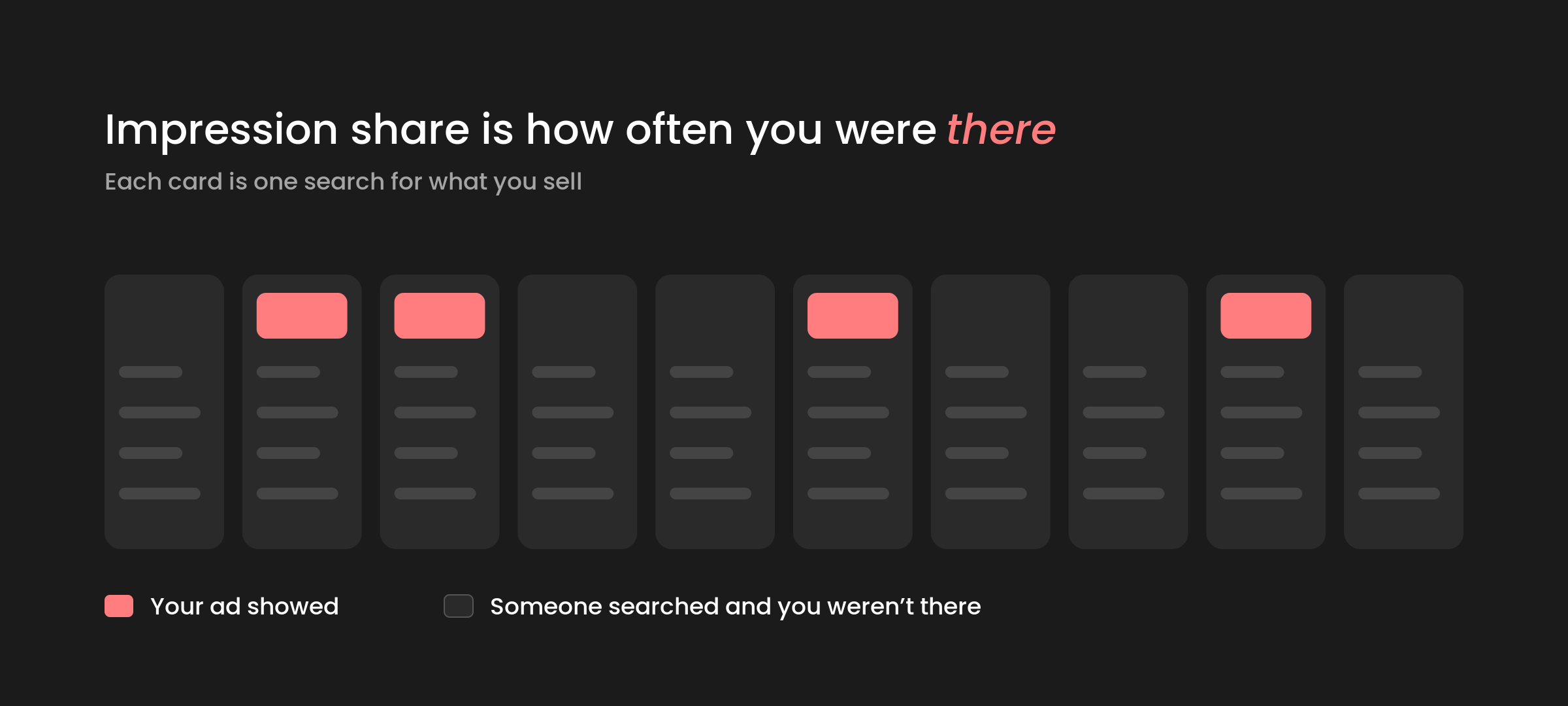
Impression share is a means to an end, so pair it with cost per qualified enquiry, worked out from your call tracking and form submissions and checked against what turned into work.
When to hand bidding back to Google
None of this means automated bidding is off the table forever. Once a campaign is bringing in steady, well-tracked conversions every month, it’s worth testing a conversion-based strategy against what you’re running now, ideally with a clear target worked out from your own margins. If you’re starting from scratch with a small budget, our guide to what to do with your first $5k a month in marketing covers where Google Ads fits.
Small accounts run on a different playbook from big ones, and most of the work is in the setup and the measurement rather than the bidding. If you’d like us to look at whether your small business’s Google Ads account is set up for the volume you have, our Google Ads team is happy to take a look, or you can get in touch directly.
How this post was made
Our own low-volume accounts shaped this post, in particular a regional WA client and a niche B2B client, because the practitioner video we started from (Grow My Ads on running Google Ads in a small town) assumes more data than many of our clients have. AI helped pull the transcripts of that video and Google’s Ads Decoded episode, and summarise Google’s help documentation. I chose the angle, wrote the argument and checked every bidding detail against Google Ads Help. Signed off by Zac Fitzpatrick.

Zac Fitzpatrick
PPC Service Lead