
For as long as I’ve done SEO, the acronym everyone quotes is EEAT. Experience, expertise, authority, trust. I’d add one more T to the end, and it’s true. Not trust, true, as in is the thing on your website correct.
Google said as much on 1 October, when it updated its guidance to say a person needs to fact-check AI content before it goes live, right down to your page titles and image descriptions. It reads like a small edit. I think it’s the start of something a lot bigger, so below is what changed, why I think it matters, and what I’d do about it this month.
Content Overview
What Google changed on 1 October
Google keeps a short page on using generative AI content on your website. On 1 October it added three sentences. The first explains that generative models “don’t retrieve facts, but predict a likely sequence of words based on their training data”, which is why AI output can contain hallucinations. The third adds: “It is critical to manually factcheck and review all AI-generated content for accuracy and trustworthiness before publishing.”
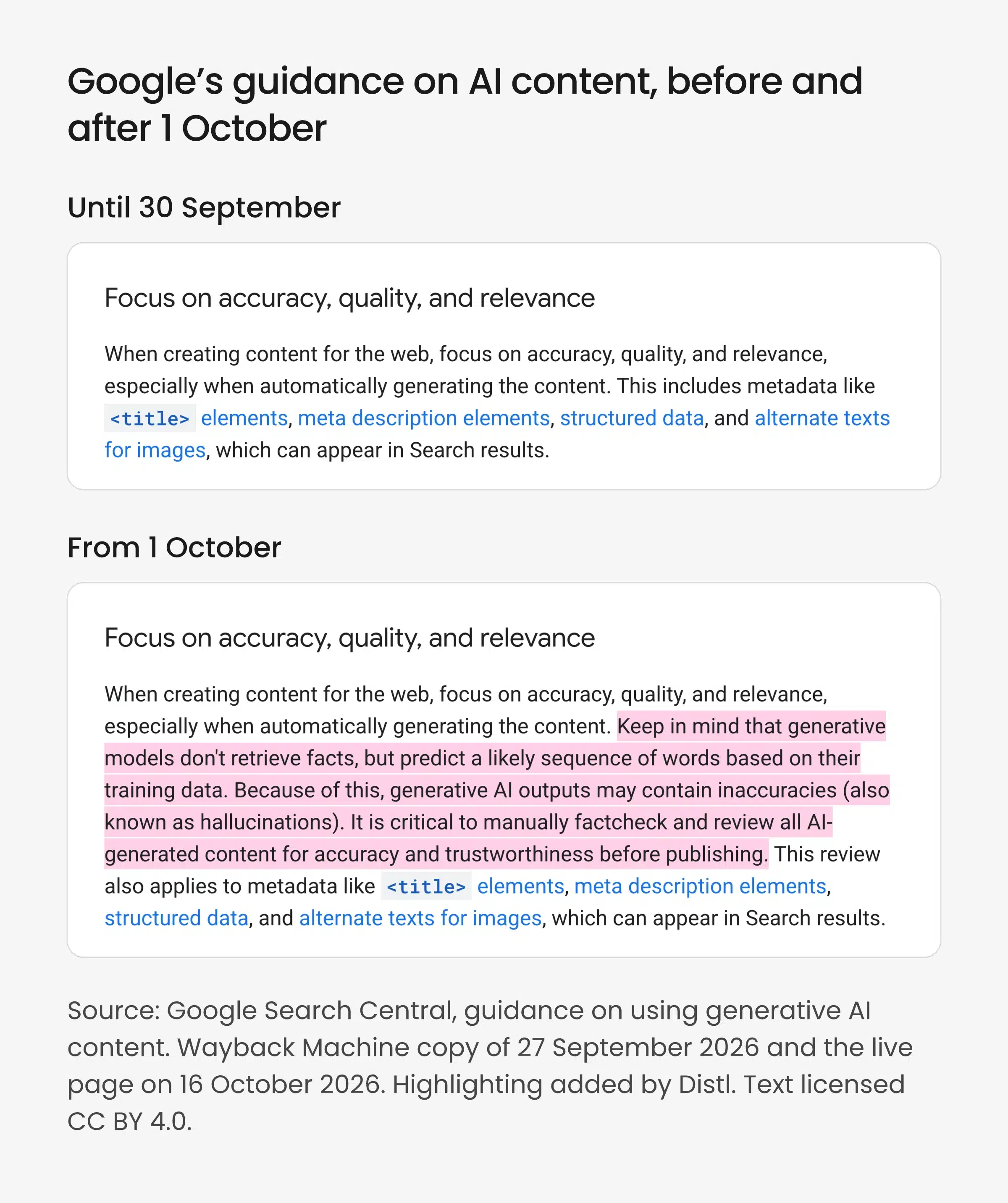
The line after it says that review “also applies to metadata like <title> elements, meta description elements, structured data, and alternate texts for images, which can appear in Search results.” Those are the bits of a website most people never look at, and they’re the bits Google shows under your name.
Nothing about rankings changed with it. Google didn’t announce a penalty, and PPC Land’s comparison of the old and new page shows the metadata line already existed in an earlier form and was reworded to hang off the new review sentence. What’s new is Google putting “critical” and “manually” in writing, in the documentation site owners and agencies quote.
How one AI mistake turns into a fact
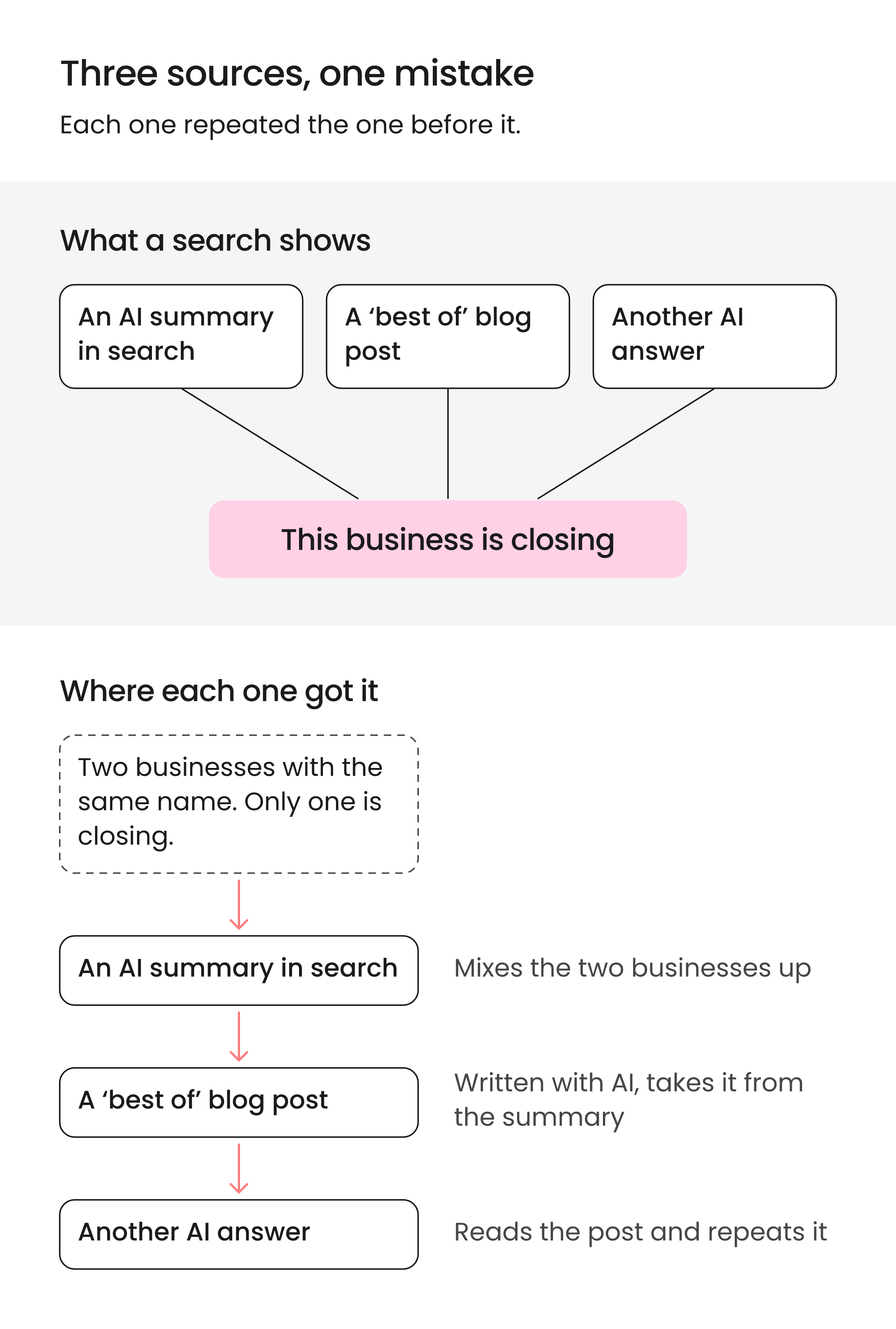
Over a weekend in July, people searching for Anna Mae’s Bakery and Restaurant in Millbank, Ontario, were told by a Google AI Overview that it was closing for good on 31 July. It wasn’t. CBC News reported that Google had mixed it up with an Illinois bakery of the same name that was closing. The owner, Amanda Herrfort, found out from a screenshot someone sent her on the way to a wedding, then spent the following days telling customers on the phone and at the counter that they were staying open. Her advice afterwards was simple: “don’t just read what AI is telling you at the top.”
That’s one AI hallucination, and it got fixed. Now picture it going another round. Someone uses AI to write a “best bakeries near Kitchener” post and picks up the closure. Another tool reads that post and repeats it. A few months later it’s three sources deep and looks like a fact, and nobody along the way meant to get it wrong.
Researchers have studied the wider version of this loop. A 2024 study published in Nature found that AI models trained on text written by other AI models get worse with each generation, losing the rarer, real-world detail first. The more AI-generated content there is online, the more of it gets fed back in, which makes a human checking the facts worth more over time.
Google already put true inside EEAT
To be fair to Google, true was never missing from EEAT. On its page about creating helpful content, Google says of experience, expertise, authoritativeness and trustworthiness: “Of these aspects, trust is most important.” The same page lists what its quality raters look for in a page’s main content, and accuracy is one of them: “For informational pages, the content should be factually accurate.” It also describes using AI “to produce large amounts of text without manual oversight or curation” as little to no effort.
So true has always been sitting inside Google EEAT. What’s changing is that it’s getting checked, and that someone pays when it’s wrong. In May a Munich court granted an injunction against Google over false claims its AI Overviews had made about two publishers, finding that the summaries speak in their own words, as PPC Land reported. Once a search engine can be held responsible for what its AI says, it has every reason to lean on sources that are right.
I think whether the things on your site are true is going to matter as much as the technical basics we already police, like internal links pointing at 404 pages. Google hasn’t said that, and there’s no ranking factor called “true”. I’d still rather our clients were early than late.
What I’d do this month
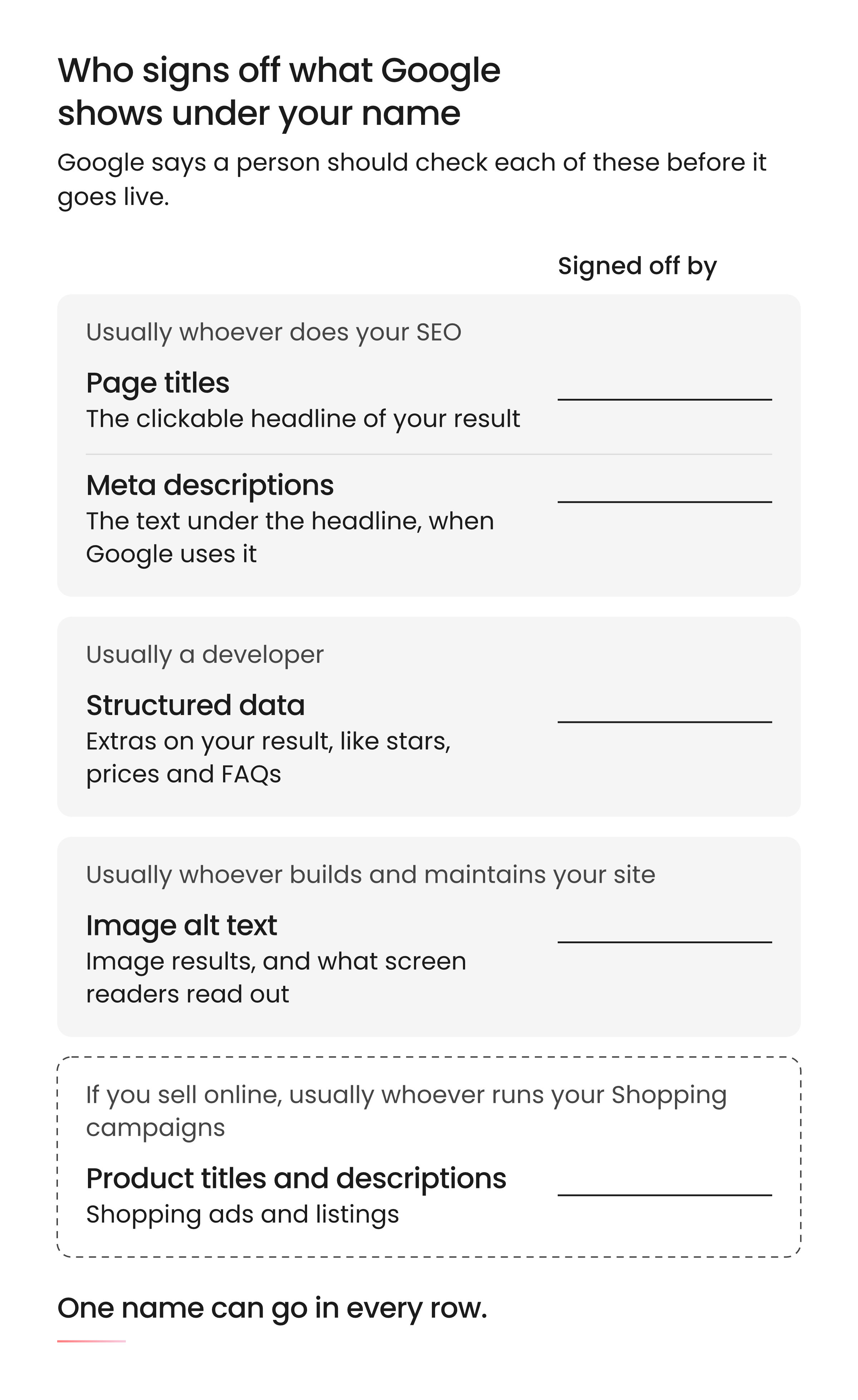
Check the four things Google named
On a lot of sites, these were filled in by a template or a plugin when the site was built and haven’t been looked at since. Run a crawl of your site (Ahrefs, Screaming Frog and Semrush all do this) and pull the pages with missing or templated meta descriptions, overlong titles, images without alt text and structured data errors. Start with the pages that get traffic in Search Console, because those are the ones people see. Our technical SEO audit checklist covers the rest of the crawl, and our guide to image optimisation covers writing alt text that describes the image rather than stuffing keywords into it.
If you run an online store, check your product feed too. Google Merchant Center requires AI-generated product titles and descriptions to be labelled as AI-generated, which matters if you run Google Shopping ads.
Put a name next to each one
Those four things usually belong to four different people. Titles and meta descriptions sit with whoever does your SEO, alt text sits with whoever builds and maintains the website, structured data sits with a developer, and product data sits with whoever runs your Shopping campaigns. When nobody owns all four, nobody checks them, so write down who signs off each one.
If your site has a couple of hundred pages, the whole check is an afternoon’s work. If you’ve got a product catalogue in the thousands, fix the templates and your best sellers first and work down from there. Either way, keep using AI to draft. Just make sure a person reads what it wrote before it goes live, which is what our SEO and web teams do on every page we touch.
Check what’s being said about you
Amanda Herrfort found out about her bakery’s closure from a screenshot. Most businesses would find out the same way, if at all. Ask ChatGPT, Gemini and Google’s AI Overviews what they say about your business and see whether it’s right. Our guide to checking what AI is saying about your business walks through it step by step.
Using AI was never the problem
People are getting warier of what they read. A Gartner survey of US consumers found 57% say AI-generated content has made them less trusting of brand messaging, and 43% now rely more on real people for recommendations. In Australia, the University of Melbourne and KPMG’s trust in AI study found only 36% of Australians are willing to trust AI at all.
Edward Sturm suggested on his SEO podcast this month that adding images and video helps distract readers from obvious AI text. I’d rather rewrite the text. We use AI on just about everything at Distl, from research to first drafts, and every piece still has a person who’ll put their name to it. That’s the check Google is asking for, and I think it’s where EEAT is heading, true included. We already wrote about the same idea for ad accounts in who checks what the AI can’t see.
If you’d like us to run the same check on your site and tell you plainly what we find, let’s talk.
Frequently asked questions
What does EEAT stand for?
Experience, expertise, authoritativeness and trustworthiness. Google uses it to describe the qualities its systems and quality raters look for in content, and says trust is the most important of the four. EEAT isn’t a ranking factor on its own, but Google says its systems use a mix of signals to find content that shows it.
Does Google penalise AI content?
No. Google says it doesn’t ban AI content, and the 1 October update didn’t add a penalty. What it cares about is whether content is helpful, accurate and made with real effort. Mass-producing pages with AI and no human review can breach its spam policy on scaled content abuse.
How this post was made
- Where it started: an episode of The Edward Show, Edward Sturm’s daily SEO podcast, about Google’s 1 October update. We used AI to pull the transcript and summarise the sources behind it.
- What a person did: the angle and the argument, that EEAT needs a T for true, are mine. The first draft was written with AI from my notes, then I edited it and made the final call on what stayed in.
- How the facts were checked: against Google’s own documentation, CBC News, the published Nature study, Gartner, and University of Melbourne and KPMG research.
- Written and signed off by: Rob Sharif.

Rob Sharif
Technical SEO Lead