
Black Friday is on 27 November this year, and the sale emails started landing in my inbox in October. If your Black Friday marketing runs for six weeks and then rolls straight into Boxing Day and the January clearance, I don’t think you’re running a sale anymore. You’re showing people your real price with a line through a fake one.
That’s a fine strategy if you’ve decided to be the cheapest. Most small stores haven’t decided that. They’ve drifted there, one discount at a time. Below is how it happens, where the ACCC fits in as you grow, and what I’d do instead.
Content Overview
A sale that never ends is just your price
Kookai learned this the hard way. The Australian fashion label leaned on promotions to drive sales during COVID. Coming out of it, creative director Bianca Vagner-Cromb told Ragtrader, they had to “retrain the customer” to stop expecting a sale. It took them a while. Her verdict on constant promotions was that they’re “great at the time, but the long-term effects can be quite drastic”.
Merry People, the Victorian gumboot brand, went the other way from day one. Founder Danielle Pearce decided early that she’d never discount, because she knew people “would just be waiting for that sale”. She told SmartCompany that other ecommerce founders had described feeling like “a slave to the sale”, discounting to hit their targets. Without the discount spikes, her sales data has no big outliers, which makes forecasting a lot easier.
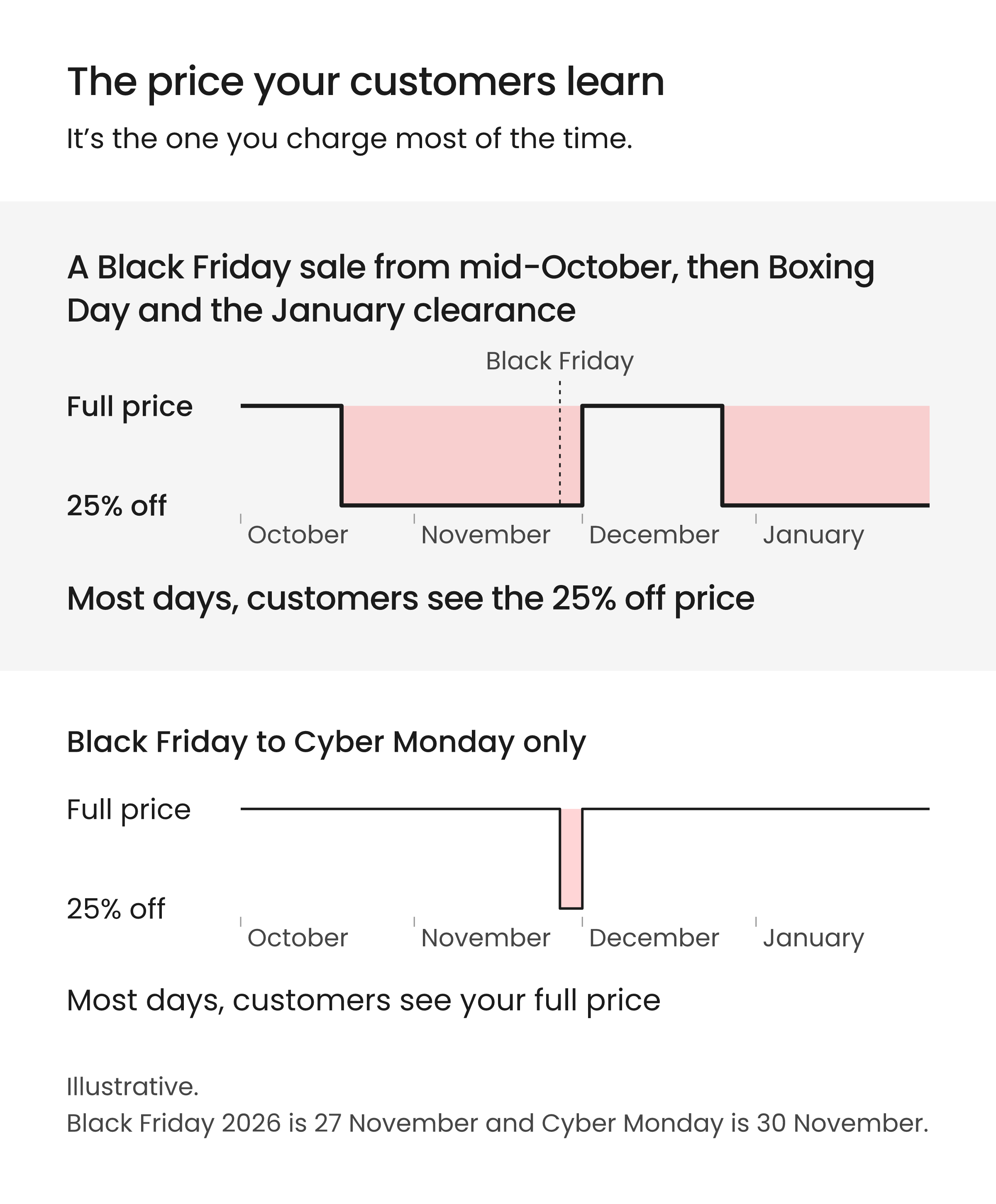
Refusing to discount is a positioning call in its own right, the kind we wrote about in brand positioning as something you refuse to do. Customers learn what your price is from what you charge most of the time. Run 25% off for half the year and that’s the number they’ll remember.
The bigger risk is chasing your own tail
If you’re a small store doing a few hundred orders a month, the ACCC isn’t the thing most likely to hurt you. The bigger problem is that you don’t have enough data to know whether your discounts work.
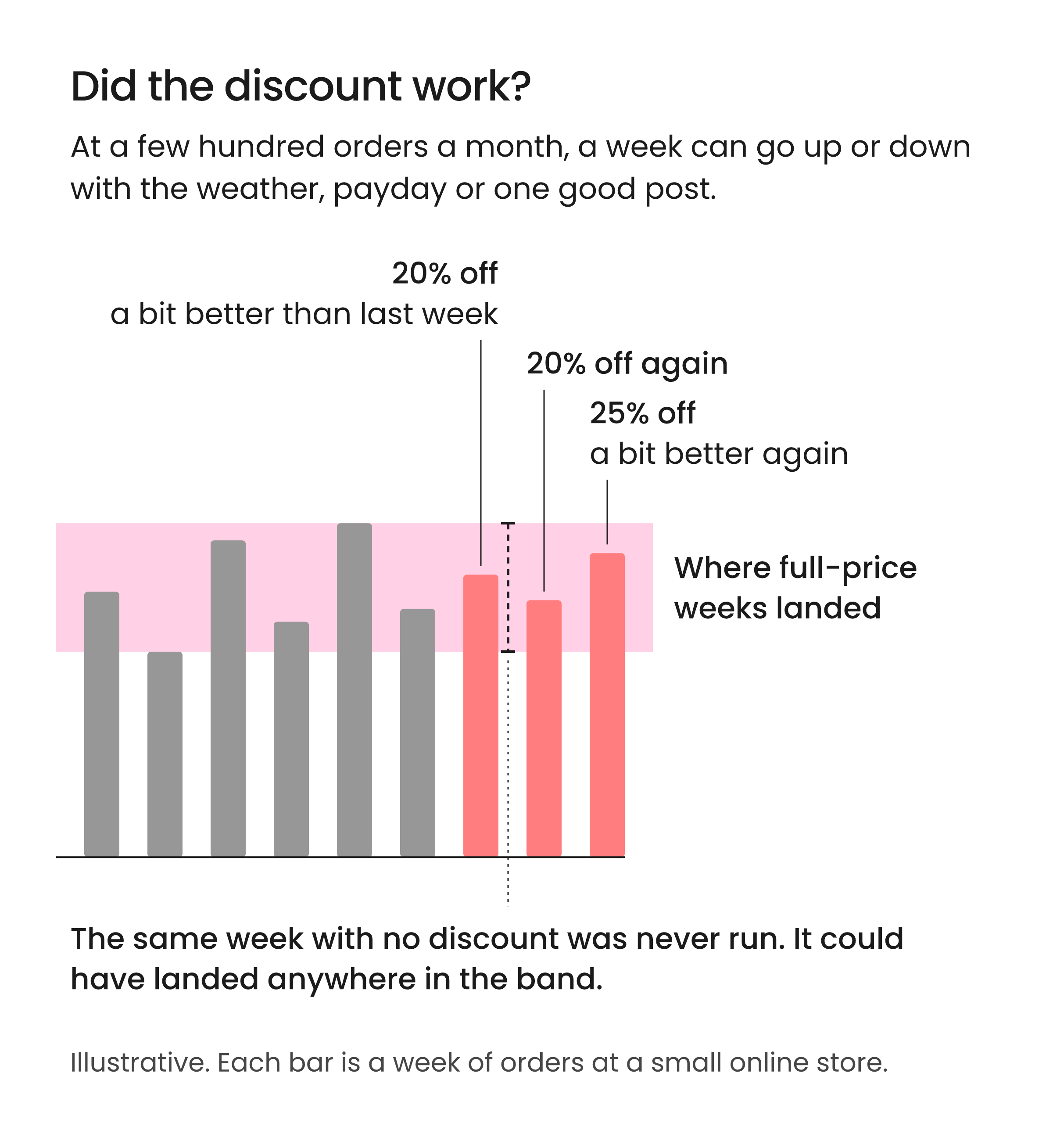
You run 20% off, the week does a bit better than the last one, so you run it again. Then 25% off does a bit better again, and that becomes the plan. What you never see is what would have happened without the discount, because you never left a week alone to compare it against. At that size, a good or bad week can come down to the weather, payday or one post doing well. The lift you’re chasing is often noise.
Most of the discount also goes to people who’d have bought anyway. Kathy Hammond and Andrew Ehrenberg looked at 175 price promotions across four countries where they could compare sales before and after with nothing else going on. Sales afterwards were within about 1% of sales before, on average, and the promotions were used mainly by past customers. That research was on supermarket brands, so it isn’t a perfect match for a Shopify store.
Ethercycle, a US Shopify agency, found something similar in its State of Discounts 2026 report, based on US online stores. Returning customers collected 67.6% of the discount dollars, and discounted orders had a lower share of new customers (30.2%) than full-price ones (32.6%). Ethercycle sells a gift-with-purchase app, so it has a side in this, but its numbers point the same way as Ehrenberg’s.
It happens to bigger brands too. On a Common Thread Collective podcast this month, the president of US brand Groove Life said discounted revenue had crept from about a fifth of their sales to two-fifths. They’ve since cut discounting back to two moments a year. If you keep squeezing every sale out of a discount, eventually there’s nothing left to squeeze. You end up living at the bottom of your own price range. We’ve seen the same trap in ad accounts, where your most profitable ads aren’t the ones that grow your business.
The ACCC is a problem you grow into
I’m not going to pretend the ACCC is watching every two-person store. Its Black Friday enforcement so far has gone after names you’d know. In June 2025, Michael Hill, MyHouse and Hairhouse Online each paid a $19,800 infringement notice after the ACCC alleged their Black Friday “sitewide” sales weren’t sitewide. Hairhouse Online’s “SAVE 20% to 50% SITEWIDE” left more than a quarter of its products out. Paying a notice isn’t an admission of breaching the law. Still, ACCC Deputy Chair Catriona Lowe said retailers “should not use small point disclaimers to terms and conditions to disguise the real extent of their offers”.
A sale that never ends runs into a different problem, which is the “was” price. In May the Federal Court found 13 of the 14 Coles “Down Down” tickets it examined were misleading. The “was” price hadn’t applied for a reasonable period first. In that case the court looked for at least 12 weeks, though Clayton Utz notes the right period depends on the product. The penalty hasn’t been set yet.
The Australian Consumer Law is the same for a two-person store as it is for Coles. If your “was” price is one nobody has paid in months, the strikethrough is a claim you can’t back up, and that matters more the bigger you get. Build the habit while you’re small. If the banner says sitewide, every product should be in it, and if it says 30% off, it should be 30% off what people were paying last month.
What I’d build instead
The alternative is slower, and I think it’s the only version that gets easier over time. People are getting warier of brands. A Gartner survey of US consumers found 57% trust brand messaging less because of AI-generated content, and 43% now rely more on real people for recommendations. When trust is that thin, a reason to buy from you does more work than a reason to buy today.
Decide who you want to be
Before you plan the next offer, work out what you want people to say about you when you’re not in the room. Cheapest? Fine, that’s a legitimate position, and some businesses win on it. Be clear that you’ve picked it, because you’ll be defending it every month against someone with deeper pockets. If you’d rather be known for something else, like the best made or the most helpful, let the discount calendar serve that.
Put the people up front
Merry People told SmartCompany it sees sales lift in the weeks it explains to customers why it won’t discount. A small store has something a big retailer can’t buy: the owner, the people packing the orders and the reason the product exists. Put them on your website, in your emails and in your ads. When people trust brands less by default, a face and a reason they believe will do more than another 10% off.
Look after the customers you’ve got
A lot of the small stores I talk to put almost all their effort into the next customer and very little into the ones they have. Build your email list properly and treat it as something you’re growing for years, not something to blast when sales are slow. Thank repeat customers with early access, a handwritten note or a gift with their order, instead of training them to wait for 20% off. Our email marketing team sets up those welcome and repeat-customer flows. Our ecommerce web design team builds stores that give people a reason to sign up beyond a discount code. None of it pays off in a week, but it keeps adding up, which a discount never does.
If you run a sale, keep it short and true
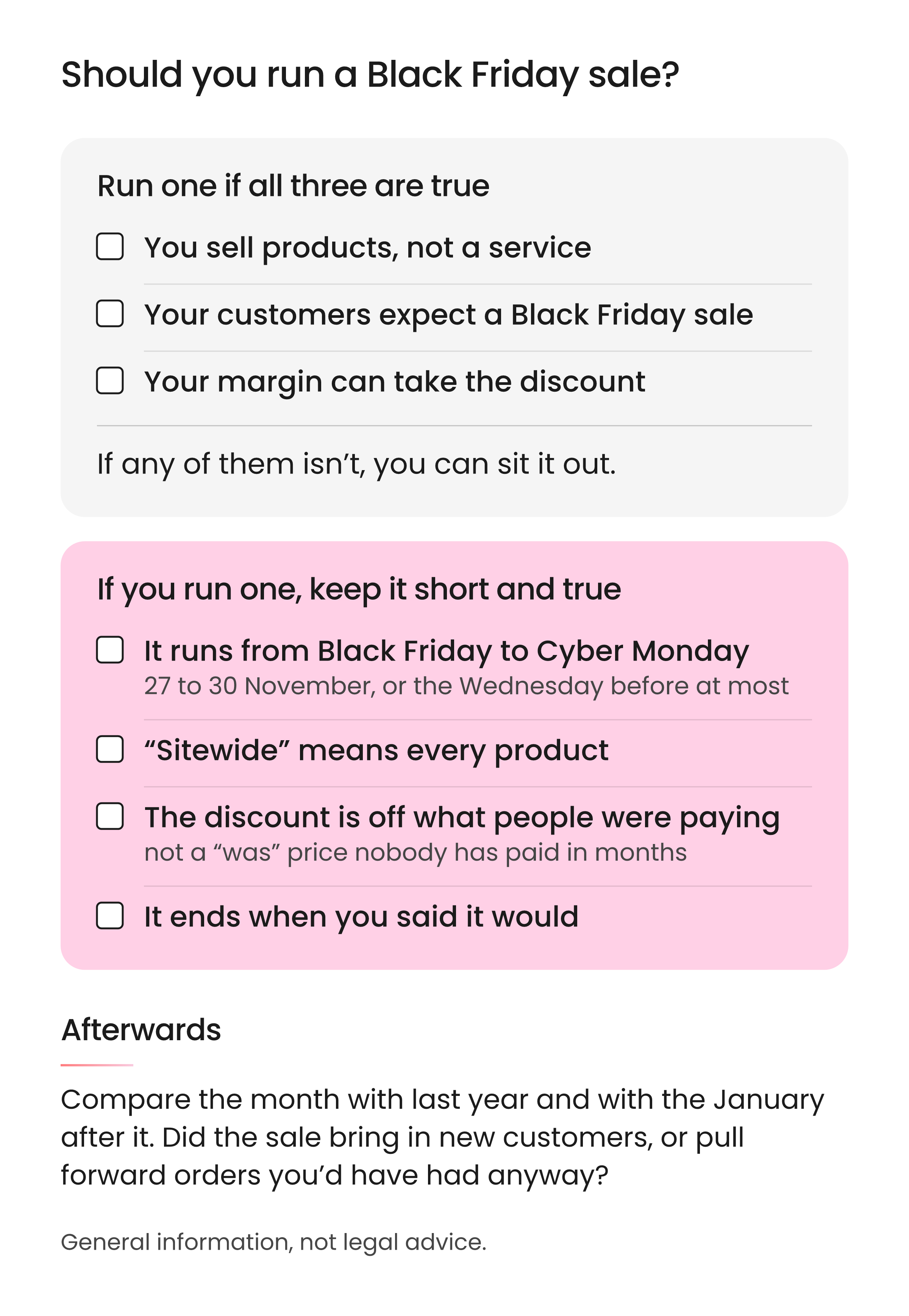
I’m not saying never run Black Friday. If your customers expect it, a short, honest sale can be a good week. Keep it tight, from Black Friday on 27 November to Cyber Monday on 30 November, or from the Wednesday before at most. Measure the discount against what people were paying, make “sitewide” mean every product, and stop when you said you’d stop. Afterwards, compare the month with last year and with the January that follows. That tells you whether the sale brought in new customers or pulled forward orders you’d have had anyway.
Black Friday marketing for small businesses: who this is for
If you’re a small online store living on 20% off, this is mostly about you. The ACCC is probably not your biggest worry this year. Spending another year chasing the next discount without knowing whether it works is. If you’re growing into a bigger retailer, the legal side starts to matter as much as the margin. If you sell services rather than products, you can usually sit Black Friday out and let the retailers fight over the ad space.
The stores I’d back long term know who they are, put their people in front of customers and treat every buyer as the start of a relationship. That takes patience, and it’s the version where your Black Friday marketing gets easier every year instead of more expensive. If you’d like help working out what that looks like for your brand, our brand strategy team is a good place to start, or let’s talk.
Frequently asked questions
Should my small business run a Black Friday sale?
Only if your customers expect it and your margin can take it. If you do, keep it short (Black Friday to Cyber Monday is plenty) and measure the discount against what people were paying. Afterwards, check whether it brought in new customers or pulled forward sales you’d have made anyway. If you sell a service, you can usually skip it.
What does the ACCC say about Black Friday sales?
The ACCC has said sales described as “sitewide” or “storewide” should deliver what customers expect, and that small-print disclaimers shouldn’t hide the real extent of an offer. Its earlier sweeps of Black Friday ads also flagged “was/now” pricing and dubious claims about the value of discounts. Under the Australian Consumer Law, a “was” price should be one you charged for a reasonable period before the sale. This is general information, not legal advice.
How this post was made
- Where it started: a Common Thread Collective podcast episode on how long Black Friday sales should run, and Ethercycle’s discount report. We used AI to pull the transcripts and summarise the sources.
- What a person did: the angle and the argument are mine. A sale that never ends is your price, and the bigger risk for small stores is chasing their own tail. The first draft was written with AI from my notes, then I edited it and made the final call on what stayed in.
- How the facts were checked: against the ACCC’s own media release, Clayton Utz’s summary of the Coles judgment, Ragtrader, SmartCompany, Hammond and Ehrenberg’s published research, Ethercycle’s report and Gartner.
- Written and signed off by: Jack Headford.

Jack Headford
Account Manager & Operations Lead