The intuition with LLMs is that anytime you ask anything it searches the entire internet for an answer, but that isn’t how it works at all. Sometimes it searches the web, and sometimes it answers from what it learned when the model was trained, which is a snapshot of the internet from a few weeks or even months ago.
OpenAI’s own wording is that ChatGPT “will choose” when to search, and unless you check for sources you won’t know which one you got. For questions about your business, that means it could be describing you as you were a year or two ago. Below is how the two work, how often it skips the search, and what I’d do about it.
Content Overview
Two ways ChatGPT answers a question
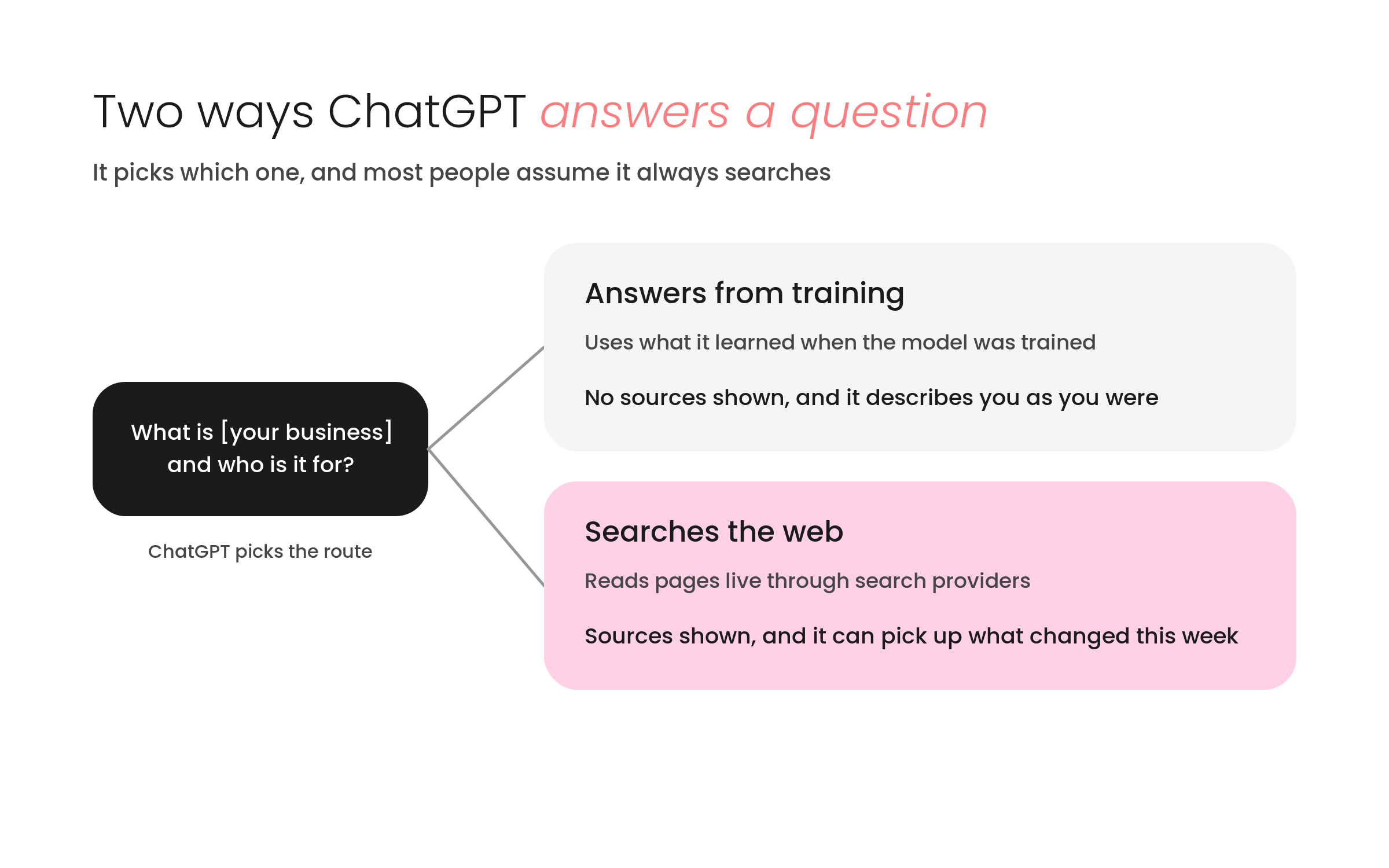
The first way is training. Before a model is released, it learns from an enormous amount of text gathered from across the web, and that gives it a picture of the world as it stood when the collecting stopped. Whatever it learned about your business then, right or wrong, is baked in, and it only changes when the model is retrained. OpenAI doesn’t publish a retraining schedule, it’s purely based on when a new model is ready or they want to release it. (This is separate from ChatGPT’s memory feature, which remembers things about you as a user.)
The second way is a live search. ChatGPT can run searches through third-party search providers, read what comes back and write its answer from that, with links to the sources. That’s the version most people picture, and it’s the one that can pick up a page you published last week.
It decides when to search, and it often doesn’t
OpenAI says ChatGPT “will choose to search the web based on what you ask”, and you can also tell it to search by clicking the web search icon. AI companies don’t explain how they make that choice. This analysis of how chatbots handle news notes that searches “are not triggered by default for every query”, and that the routing behind the decision “likely changes constantly and varies from platform to platform”.
How often it skips the search moves around too. One company that tracks about 3,000 ChatGPT answers a day saw the share of answers with no sources at all jump from 1.5% to 12.2% overnight on 31 October, and it held for at least the next ten days. Its read is that ChatGPT started searching less after an update, though OpenAI hasn’t said so, and another tracker saw a similar jump in March that mostly reversed by May. It sells AI tracking, so it has a stake in the numbers, but on its data about one answer in eight it tracks is coming straight from what the model already knows.
Even more complicated again is how often different models from the same LLMs search, i’d wager that Free accounts search less often to use less compute on non paying users.
What that means for your business
When ChatGPT answers about your business without searching, you get one of three things.
- If it learned something accurate and nothing’s changed, you’re fine.
- If it never learned much about you, which is common for smaller Australian businesses that don’t get written about much, you get a vague answer or nothing at all.
- And if your business has changed since the model was trained, you get the old version.
That last one catches people out. If you’ve rebranded, moved, changed your prices, added a service or stopped offering one in the last year or two, ChatGPT may still describe the business you used to be whenever it doesn’t search. Updating your website fixes the searched answers quickly, but it does nothing for the answers that come from training until the next model learns the new version.
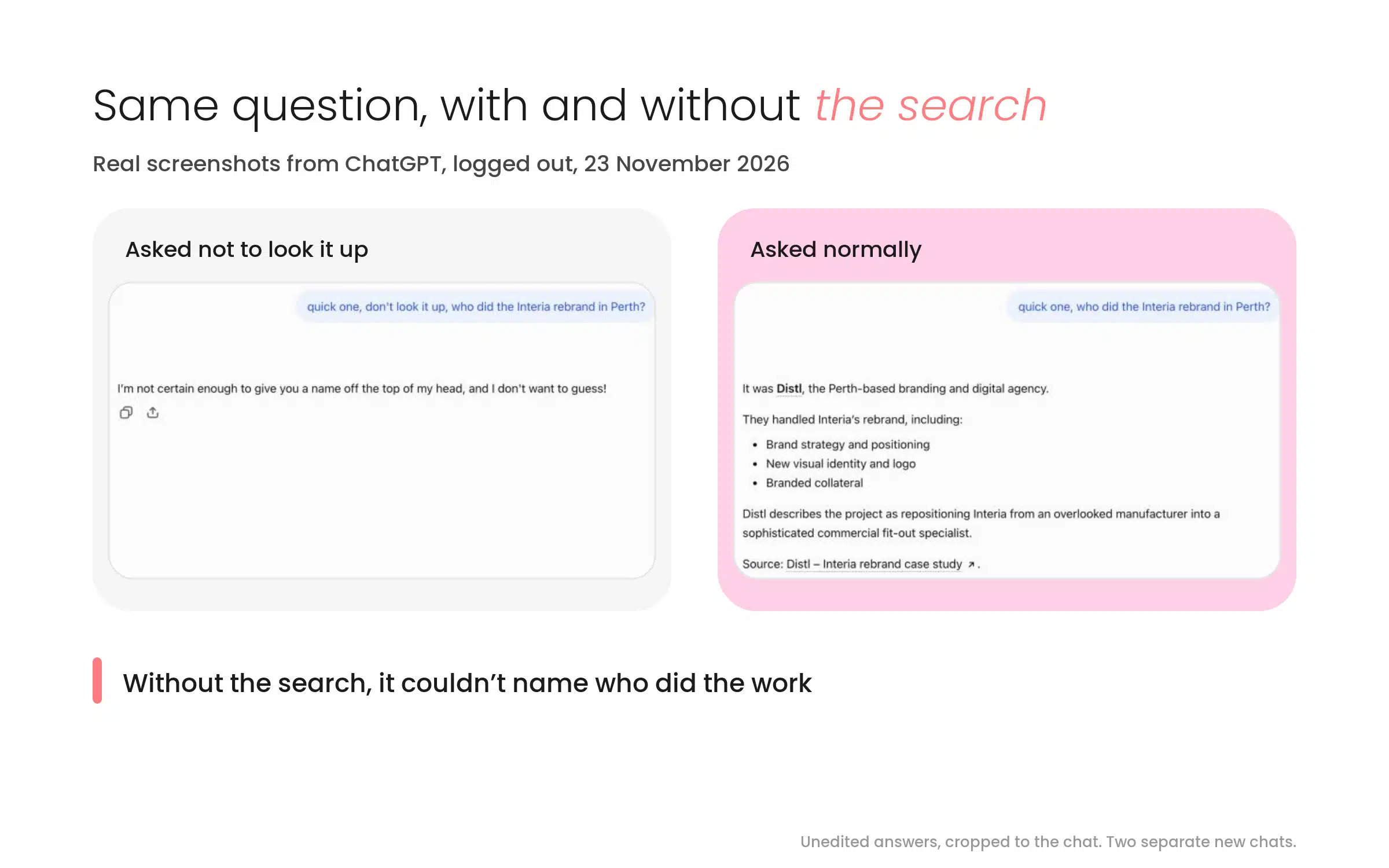
We tried it on ourselves, logged out of ChatGPT. Interia is a rebrand and website we published as case studies this year. Asked “quick one, who did the Interia rebrand in Perth?”, ChatGPT searched, found our case study and named us. In a new chat we asked the same thing with “don’t look it up” added, and it said it wasn’t certain enough to give a name. Nothing about the work changed between the two questions, only whether ChatGPT went looking.
What it already knows shapes what it searches for
The common advice in AI search circles (this explainer has been watched more than 100,000 times) is that training data doesn’t matter much, because you can’t change it quickly and search is where you can make a difference. I can see why, since search is the part you can influence this week. I think it undersells the training side, though.
One SEO who tested this on Google’s Gemini found that when it searched, it tended to go looking for brands it already knew, by name, to check what it already believed about them. Less familiar brands only turned up when the model happened to search for them specifically (you can read his explanation in this interview). That was one test, on one model, in one category, so I’d treat it as an early finding. If the same holds for ChatGPT, what it learned about you a year ago decides whether it even looks for you today, which makes being known in the first place a brand job as much as an SEO one. We’ve written before about why branding matters in AI search, and this is a big part of the reason.
What I’d do about it
Start by testing it. Open ChatGPT logged out, or in a temporary chat, and ask “What is [your business] and who is it for?” When we named Distl, ChatGPT searched on its own every time, which is a good sign for questions that name a business. Then start a new chat and ask the same thing with “don’t look it up” added. That second answer is the version ChatGPT falls back on whenever it doesn’t search, and if yours is out of date or missing, that’s the gap to work on. Try it on a recent project or service too, since that’s where the training version is most likely to be behind.
Then work on both sides. For the searched answers, keep everything you control current and consistent: your website, your Google Business Profile, your directory listings and your About page. Make sure your site isn’t blocking the crawlers that collect this material, which some hosts and security settings can do without you knowing. For the training side, get the current version of your business written about in places that get read and repeated, like local and trade press, industry associations, reviews and podcasts. That’s slow work, and it’s what shapes what the next model learns.
Check again every few months, because the answer will change as the models do. Our post on what AI is saying about your business has the full list of fixes, and if you’ve claimed your listing, ChatGPT’s Business Hub (still in beta) gives you some of OpenAI’s own numbers alongside your own testing.
If you’d like help working out what ChatGPT thinks your business is and how to change it, that’s what our generative engine optimisation work covers, and the brand side sits with our brand strategy team down the hall. Let’s talk.
Frequently asked questions
Does ChatGPT search the web every time?
No. OpenAI says ChatGPT chooses whether to search based on what you ask, and you can make it search by clicking the web search icon or asking it to. If an answer doesn’t show any sources, it most likely came from what the model learned in training.
How often is ChatGPT’s training data updated?
Only when OpenAI trains and releases a new model, and it doesn’t publish a schedule for that. In between, anything that’s changed about your business only reaches ChatGPT’s answers when it searches.
How this post was made
- Where it started: a run of SEO and AI search podcasts and interviews on how AI tools learn about brands, plus new tracking data on how often ChatGPT skips the search. We used AI to pull the transcripts and summarise the sources.
- What a person did: the angle is mine. Most people don’t realise ChatGPT often answers from an old snapshot, and that snapshot shapes what it searches for too. The first draft was written with AI from my notes, then I edited it and made the final call on what stayed in.
- How the facts were checked: against OpenAI’s own description of ChatGPT search, the published research and tracking data linked above, and the interview transcript.
- Written and signed off by: Cam Dobie and Jack Headford.

Cam Dobie
Senior SEO Specialist