
Google isn’t pulling back on AI. Last week it told investors it’ll still spend US$195 to 205 billion this year on AI data centres and chips, and “significantly” more next year. That’s a lot of money, and somebody has to pay for it. Google’s answer, on the same call, was advertisers, and since 28 October that includes ads inside Google’s AI Mode in Australia.
Here’s what Google said, why I think the money matters more than the headline, and what I’d watch over the next year if you rely on Google for customers.
Content Overview
- What Google told investors last week
- AI Mode searches make Google less money (for now)
- Google’s fix is ads, and they’re in AI Mode in Australia now
- Publishers are copping it too
- Why everyone’s content is starting to taste the same
- A lot of your customers don’t like AI, and some flat out hate it
- What I’d keep an eye on over the next 12 months
What Google told investors last week
Alphabet’s third-quarter results came out on 28 October. Revenue was up 25% and the share price still dropped close to 10% overnight. Investors didn’t love how much cash the AI build is chewing through, which is where all the “Google’s pulling back” headlines came from. There was no cut. Google kept its spending forecast where it was, and said demand is so far ahead of supply it’s renting computing power off other companies.
I’m not going to pretend I know whether all that spending pays off for Google’s shareholders. What I care about is how Google plans to make the money back, because that’s the bit that ends up on your search results page.
AI Mode searches make Google less money (for now)
The line from the call that stuck with me came from Philipp Schindler, Google’s chief business officer. Search revenue still grew 12%, just slower than earlier in the year, and he gave a few reasons. Currency swings were the biggest one. Further down the list was this: “the strong growth in AI Mode queries had an impact because of the lower monetization we were seeing in AI Mode.”
So people are using AI Mode more, and those searches earn Google less than the old list of links. CEO Sundar Pichai said search queries are growing at their fastest rate in five years, and AI Mode questions are on average three times longer than a normal search. More searching that earns less per search is a problem Google has to fix, and the fix is ads.
A year ago I wrote that AI Mode wouldn’t change much straight away, because you had to choose to use it. It’s still optional. It’s also big enough now that Google’s explaining it to investors, so I’d stop treating it as a side project.
Google’s fix is ads, and they’re in AI Mode in Australia now
On 28 October Google said it’s scaling ads in AI Mode to ten new countries, and Australia’s one of them. Until now, ads inside AI Mode were US only.
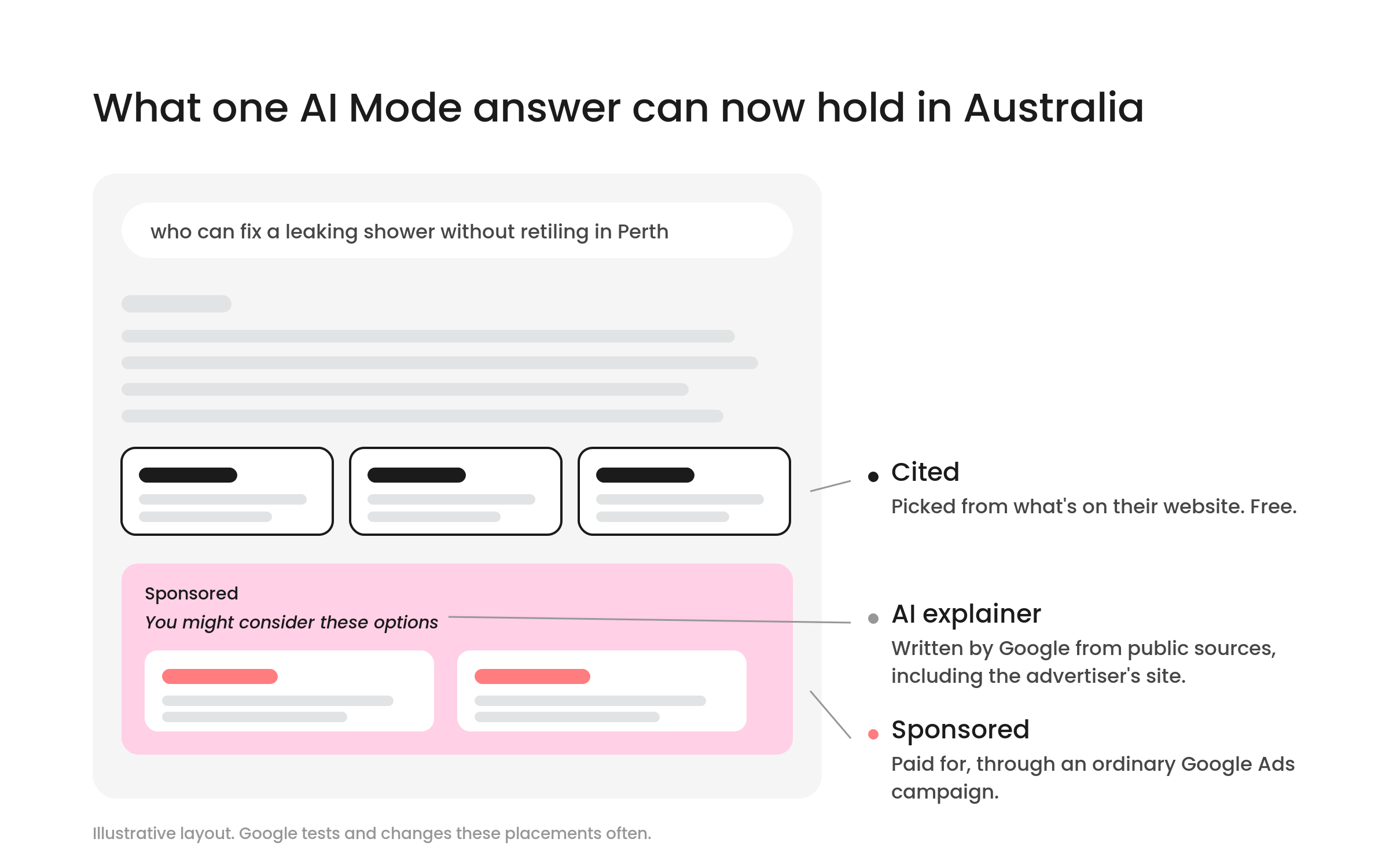
If you run Google Ads, you’re probably already in. Google’s help documentation says existing Search, Shopping and Performance Max campaigns are automatically eligible, and you can’t opt out of AI Mode separately from the rest of Search. It all gets folded into your normal reporting too, so there’s no tidy AI Mode line to look at. Exact and phrase match keywords only show when the search itself is clearly commercial. Broad match, AI Max and Performance Max can also show up when someone starts showing buying intent halfway through a conversation.
Then there’s the “AI explainer”. Next to some ads, Google writes a short blurb from the search, its own answer and public sources, including your website, and advertisers can’t edit these or turn them off. So your website now shapes how your ads get described, as well as whether Google cites you for free.
Google says paid ads don’t change what its AI says in the organic answer. Even so, one AI answer can now hold the business Google chose to cite and a business that paid to be there. Ad settings and eligibility rules change all the time, so our Google Ads team checks what’s current, account by account, before we touch anything. Zac’s guide to adapting your Google Ads for AI Mode goes deeper on the campaign side.
Publishers are copping it too
The old deal with Google was pretty simple. You let it read your content, it sent you visitors. AI answers mess with that deal, because people get what they need without clicking anywhere.
Publishers have noticed. In February the European Publishers Council lodged an antitrust complaint with the European Commission, Reuters reported. Its chairman said AI Overviews and AI Mode “fundamentally undermine the economic compact that has sustained the open web”. Reddit, which built a lot of its audience off Google traffic, told investors last week its search referrals fell by more than a million a week on average in October. It’s now moving towards a logged-in experience, TechCrunch reports.
Most Australian small businesses aren’t publishers, but the same squeeze hits your blog and your how-to pages. If a question can be answered in the AI box, fewer people click through to your guide on it. The pages that still get the visit are the ones where someone needs to see your work, properly compare their options or talk to a person.
Why everyone’s content is starting to taste the same
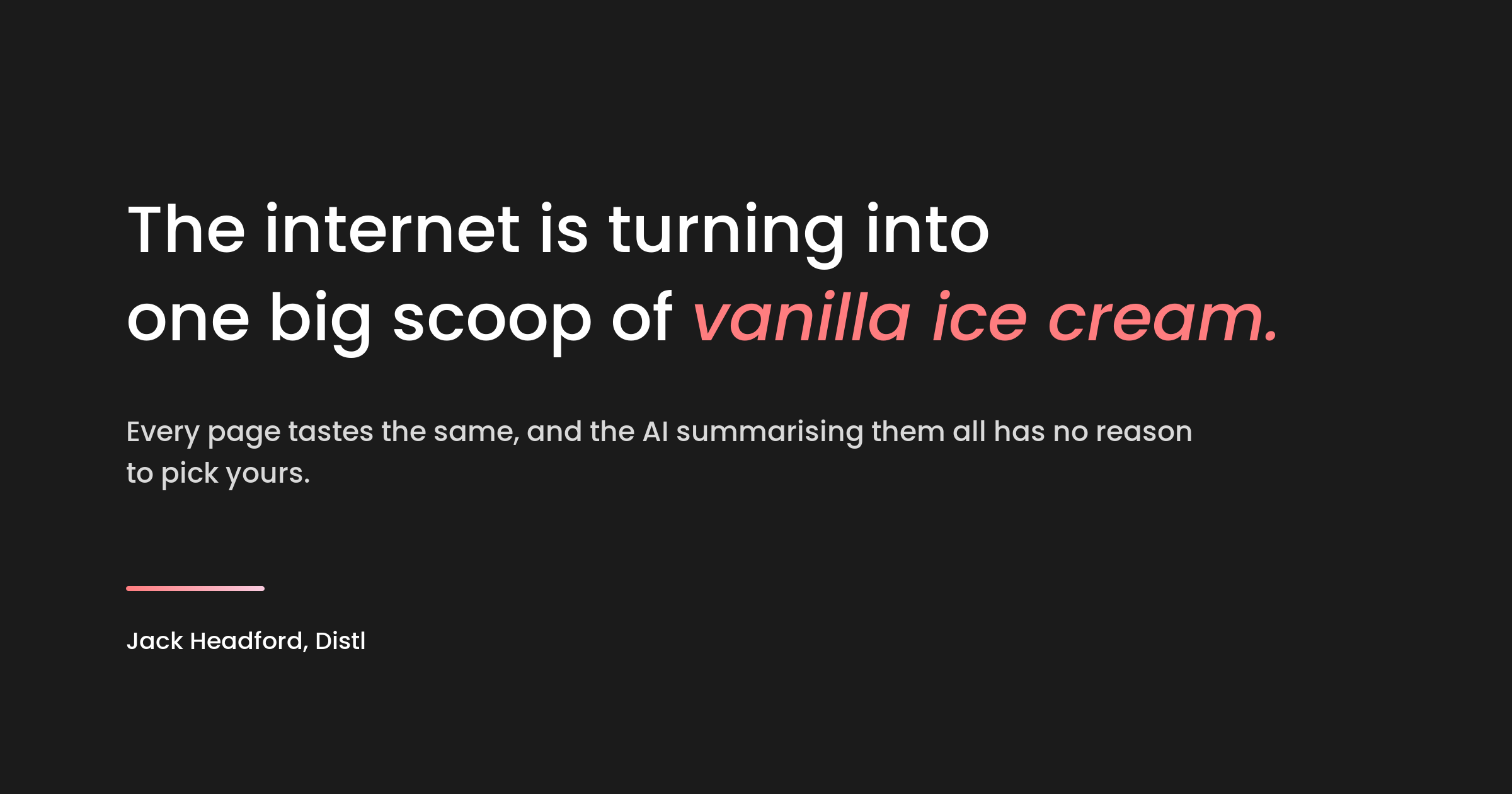
Everyone’s racing to show up in AI answers, and a lot of businesses are using the same AI tools to write the same content, often off near-identical prompts. I reckon the internet is turning into one big scoop of vanilla ice cream. Every page tastes the same, and the AI summarising them all has no reason to pick yours.
Google has a name for the worst of it. Its spam policies list “using generative AI tools or other similar tools to generate many pages without adding value for users” as scaled content abuse. Pages inside the rules still have a problem though, an AI answer built from twenty near-identical pages doesn’t need to credit any of them.
I went through this in more detail in you can’t outprompt your competitors. A better prompt won’t make you stand out when your competitors have the same tools. What stands out is the stuff only you have, like your prices, your process, your photos, your clients’ results and the questions customers ask you at the counter. Getting that in front of AI search is most of what our GEO team does.
A lot of your customers don’t like AI, and some flat out hate it
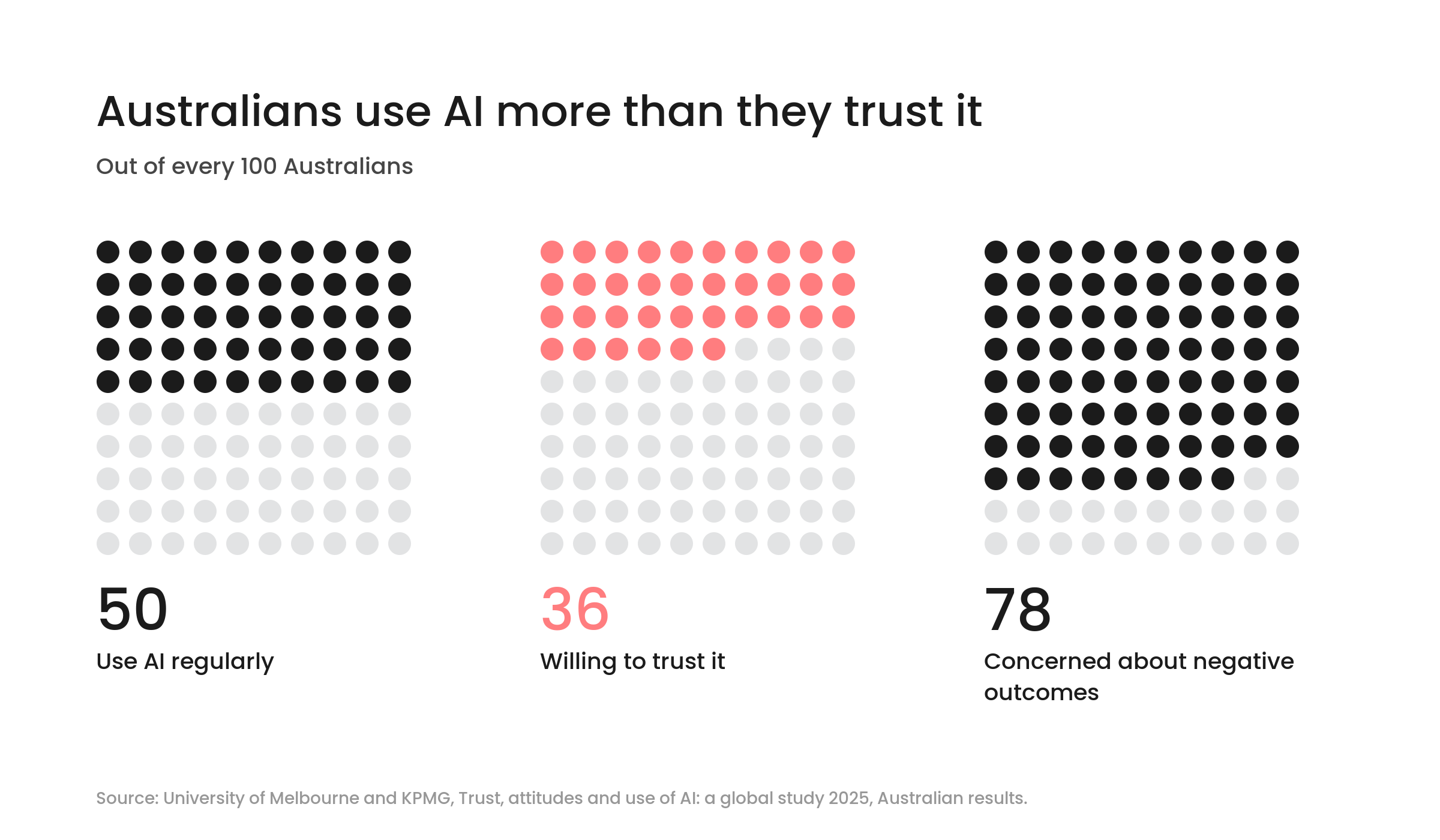
While Google pushes AI deeper into search, a lot of the people searching aren’t fans. The University of Melbourne and KPMG’s 2025 global study found half of Australians use AI regularly, but only 36% are willing to trust it, and 78% are concerned about negative outcomes. Overseas, 63% of consumers told The Harris Poll they’d be less likely to buy from a brand that uses AI-generated ads, Marketing Brew reported.
Some of them will use AI Mode anyway, it’s sitting right there in Google. When they click through, they want to land somewhere that feels like a real business, with real people, real proof and a phone number someone picks up. Leading with “AI-powered” in your marketing tends to work against you with this crowd. We use AI behind the scenes at Distl and we’re upfront about how on our how we use AI page. A named person still signs off every piece of work though, and that’s the bit clients care about.
What I’d keep an eye on over the next 12 months
None of this means SEO is dead, and you don’t need to rebuild your marketing this month. Google’s spending more on AI than ever and building it into search, so search isn’t going anywhere. What’s changing is how much free space is left on the page and who’s paying for the rest. Here’s what I’d be watching.
- More ads creeping into AI answers. Google’s already showing ads on follow-up questions in AI Mode in the US, and it’s testing sponsored products inside the organic product carousel. I’d expect both to turn up here at some point.
- Your Google Ads search terms since 28 October. If you’re running broad match, AI Max or Performance Max, look for longer, chattier search terms and check whether they’re turning into real enquiries. If your conversion tracking counts every form fill the same, fix that first.
- What AI says about you. Ask Google’s AI Mode and ChatGPT the questions your customers ask and see who comes up. Our guide on what AI is saying about your business walks you through it.
- AI visitors in your analytics. When we went through more than 100 GA4 properties, the default setup was missing about half the AI traffic. Those visitors out-converted the site average on about four in five sites.
- Your how-to and FAQ pages. If a page answers a question in a paragraph, AI can lift it. Add the stuff it can’t lift, like your numbers, your examples, your photos and a person to talk to.
If you want us to have a look at how your business shows up in Google’s AI Mode in Australia, in the ads and in the answers, let’s talk.
How this post was made
AI tools pulled the transcripts of Alphabet’s Q3 2026 earnings call and a handful of industry videos, helped summarise them and drafted from my outline. I picked the angle, wrote the argument and made the final call on what went in. The figures were checked against Alphabet’s own Q3 2026 results and earnings call, the AI Mode details against Google’s announcement and its Google Ads help documentation, and the survey numbers against the original reports. Written and signed off by Jack Headford.

Jack Headford
Account Manager & Operations Lead