A customer persona describes who buys, down to the car in their driveway, but not what happened the week they decided to buy.
But who someone is isn’t why they buy, something changed for them first. Five calls to your most recent customers will tell you what changed, what else they considered and what nearly stopped them. Their answers belong in your ads, your landing pages and your About page.
Content Overview
What a customer persona misses about Mary and her BMW
You’ve probably seen a persona like this one. Mary, 42, marketing manager, two kids, drives a BMW, listens to podcasts on the commute. It’s a common shape for a buyer persona or marketing persona, and every detail on it might be true. None of it explains why Mary rang you instead of someone else, or what happened the week she decided to buy.
Clayton Christensen used himself as the example in a 2016 Harvard Business Review article written with three co-authors. He was 64, six foot eight, wore size 16 shoes and drove a Honda minivan. None of those traits, the authors pointed out, was why he bought the New York Times. He might buy it because he needed something to read on a plane.
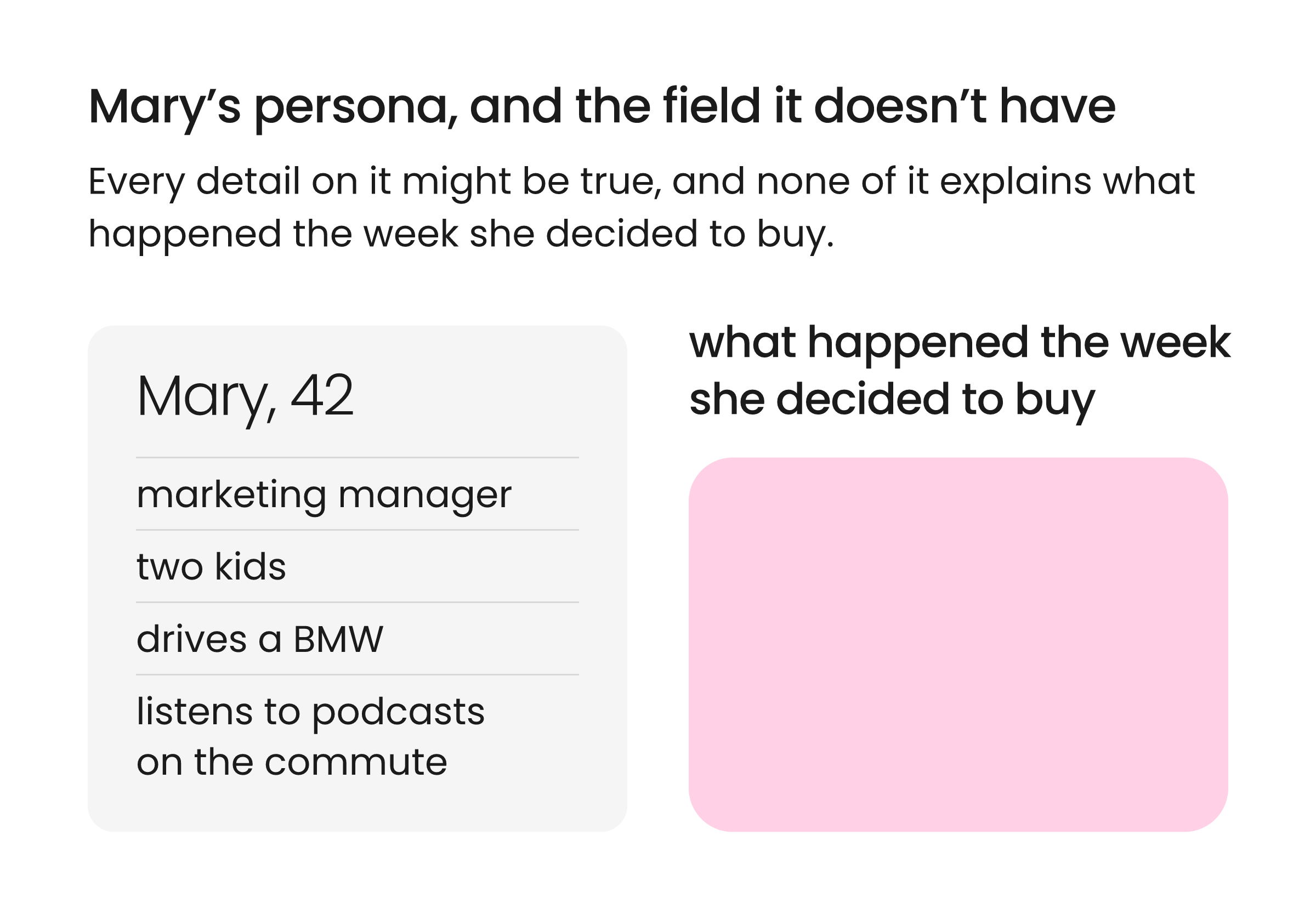
A persona can be useful when it’s built properly. But if your customer profile came from a template or AI tool and nobody spoke to a customer, it’s a guess with a stock photo.
Meta leans on those demographic boxes less than it used to, as well. What your ad says now does more of the finding than your audience settings do. We’ve covered why your audience targeting isn’t doing what you think it’s doing.
If your customer persona was built from customer conversations and records what triggered each purchase, keep it. If it’s mostly age, income, job title and hobbies, it tells you who, and you’ll need to go and find out why.
People buy when something changes
People buy when something in their world changes and whatever they’ve been doing to get the job done stops working. The same idea sits underneath the jobs to be done framework, which Christensen and his co-authors explain in that HBR piece. Their definition: “When we buy a product, we essentially ‘hire’ it to help us do a job.”
Bob Moesta and Chris Spiek, who created the switch interview, describe four forces behind every switch. Push from the current situation and pull from something better drive it, while anxiety and habit hold it back. Their shorthand for the first one is “No push, no search.”
One of the HBR article’s examples is a condo developer selling to downsizers, with weak sales. HBR notes there “wasn’t a clear demographic or psychographic profile of the new-home buyers.” Moesta asked buyers to “draw a timeline of how they got here,” and one piece of furniture kept coming up. People kept saying, “As soon as I figured out what to do with my dining room table, then I was free to move.”
The developer started helping with the move itself and raised prices by $3,500, enough to cover moving and storage at a profit. By 2007, with industry sales down 49%, HBR reports the developer had grown its business by 25%.
For a Perth business, the change behind a purchase is usually something concrete. Think of the kind of thing you might hear: the old supplier retired, a one-star review landed, the spreadsheet fell over at tax time. None of it appears on a persona, and you’ll only hear it if you ask.
How to run five customer calls this week, and the five questions to ask
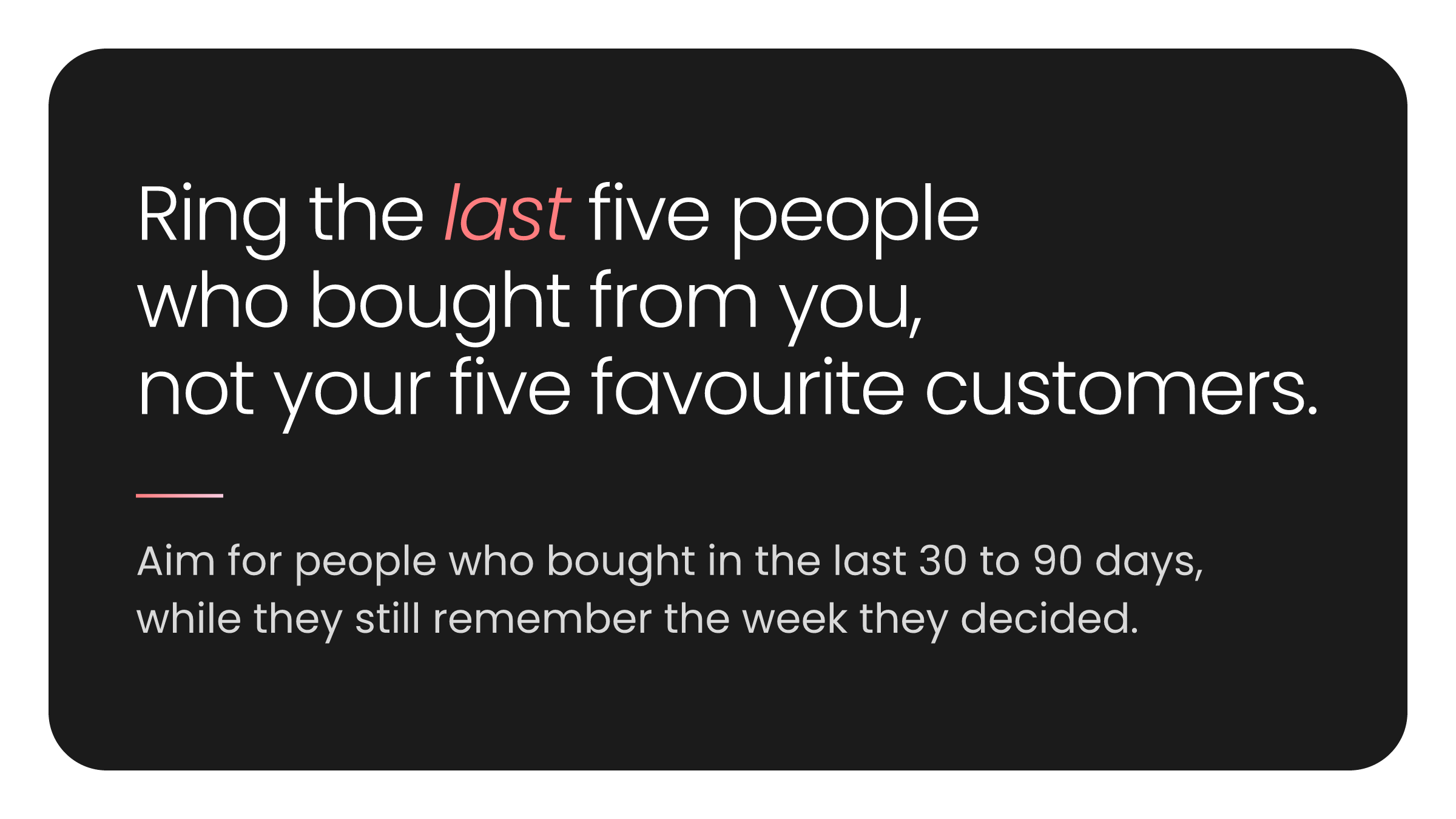
Ring the last five people who bought from you, not your five favourite customers. This is customer research with no budget attached: a phone, a notepad and a couple of hours across the week. Asking new customers how they found you is a good habit. We recommend it in what to do with your first $5k a month in marketing. These calls start further back, with what was going on before they went looking.
Who to call
Aim for people who bought in the last 30 to 90 days, while they still remember the week they decided. Moesta and Spiek’s guide to the switch interview says memory fades fast, and beyond about 90 days the details you need are gone. They also warn against recruiting your happy best customers. If you can, include someone who nearly bought and didn’t. Ask more than five people, because not everyone will say yes.
How to run the call
Book 20 to 30 minutes. Ask about events in the order they happened. Capture events, not general steps and just keep asking “then what happened?”. Don’t pitch, and don’t defend your business when they mention something you’d rather not hear.
Write down their exact words, don’t corporate them all or soften them it will dilute your messaging later.
The five questions
- When did you first start thinking about [the problem you solve]? What was going on at the time? This one finds the trigger.
- What were you doing about it before you came to us? You’ll hear the habit, and often the do-it-yourself option.
- What else did you look at, or think about doing instead? That’s who you’re competing with, including doing nothing, AI or a mate’s referral.
- What nearly stopped you? The answer is the anxiety your marketing has to settle.
- What happened that made you get in touch that particular week? This is the tipping point, and it tends to make the best ad hook.
Where the answers go: your ads, landing pages and About page
Keep their words exactly as they said them. Intercom co-founder Des Traynor describes the risk in a sidebar to the same HBR article. People using the product to sign up new customers kept saying “engage”, while Intercom’s own term was “outbound messaging”. Traynor says Moesta finds this common: “Companies fall in love with their own jargon.”
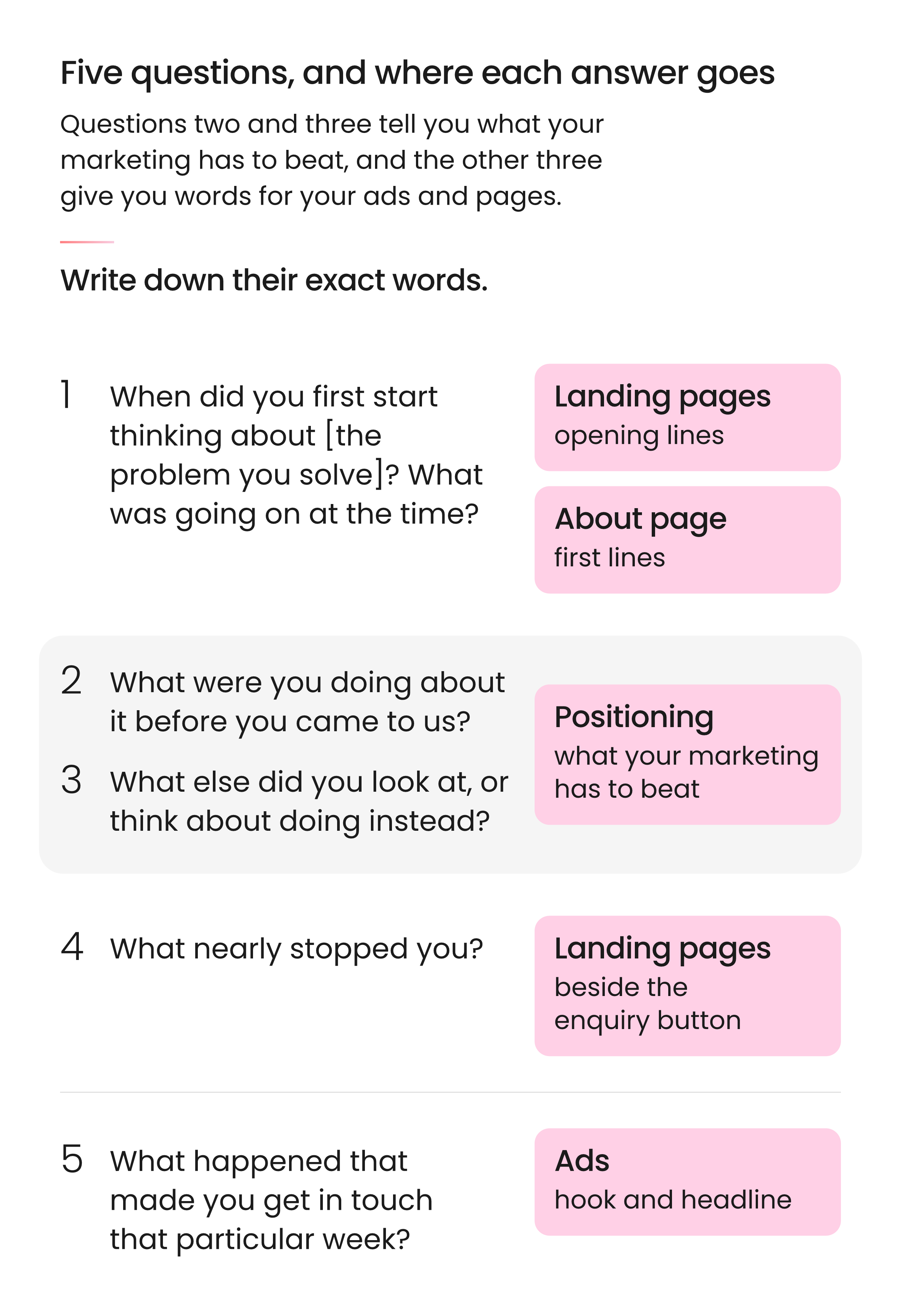
Ads. The answer to question five is often your hook, and the customer’s own phrase can be your headline. If you run Google Ads, compare the words people used on the phone with your search terms report, and write ads that use both. Customer phrasing is voice of customer data, and no template can give it to you.
Landing pages. Open with the situation they described in question one, the push that got them looking. Then answer question four, what nearly stopped them, right beside the enquiry button with guarantees, proof and a plain account of what happens next. Moesta and Spiek say anxiety is reduced “with guarantees, social proof, onboarding, and removing risk from the decision.”
About page. If yours opens with the year you started, rewrite the first lines so a visitor recognises the situation from question one, in your customers’ words. The founding story can sit further down.
Positioning. Questions two and three tell you what your marketing has to beat. Bourgoin points businesses at the problem that hurts, costs money and isn’t being solved well by anything else. If the calls keep describing a problem your brand never mentions, your brand strategy needs another look before your ad budget does.
Repetition. Bourgoin also notes that businesses tire of their own message much sooner than their customers do. Once you’ve found the words, keep using them for longer than feels comfortable.
Where AI helps, and the part it can’t hear
AI is useful around these calls, as long as it isn’t standing in for them. It can transcribe a call and pick out the phrases that repeat across five transcripts. Point it at your reviews, your competitors’ reviews and forum threads, and it’ll show you how customers describe the problem. Once you have the phrases, it can draft ad variations for you to edit, and before the first call it can help you road-test your questions.
Where AI falls short is the listening. Imagine a customer who goes quiet for a few seconds, then says, “Honestly, we were desperate.” An AI summary of the transcript can’t hear the pause. The person on the call hears all of it, and can ask what happened next.
Skipping the calls and asking AI to play your customer doesn’t hold up either. Nielsen Norman Group tested synthetic users against three of its own studies with real participants and found the answers shallow and overly favourable. In its words, “Real people care about some things more than others. Synthetic users seem to care about everything.” Where it does see a use is in preparing for research with real people, such as piloting an interview guide.
Bourgoin’s rule of thumb is to save intensive research for make-or-break decisions. If you’re choosing between two ad headlines for next month, run both and let the results decide. If you’re deciding what your homepage says or how you position the business, ring people.
Ring them this week
You don’t need to rewrite your customer persona to get started. This week, ring the five people who bought from you most recently, ask the five questions and write down exactly what they say. Then rewrite one ad and the first lines of one page using their words, and see what happens. Five calls are a start, and you can ring five more next month.
If the calls tell you your positioning or your website is saying the wrong thing, talk to us. We’ll help you work out what to change first.

Kate Wright
Senior Brand Strategist & Account Manager