
If your October SEO report shows keywords falling off a cliff, most of that fall probably didn’t happen. Since late September, Google has been feeding rank trackers fake results, so the tools record drops that real searchers never saw. Your month isn’t lost, though. Open Google Search Console, find the pages you’ve been working on and check whether they earned more impressions and clicks. That’s the better way to do SEO reporting anyway, in a wonky month or a normal one.
Content Overview
- What happened to rank tracking
- Not every drop this spring was fake
- Will rank tracking settle down?
- How to check your SEO results in Search Console
- Why the page beats the keyword, every month
- What rankings are still good for
- Frequently asked questions
- SEO reporting when rankings are wonky: what to do this month
What happened to rank tracking
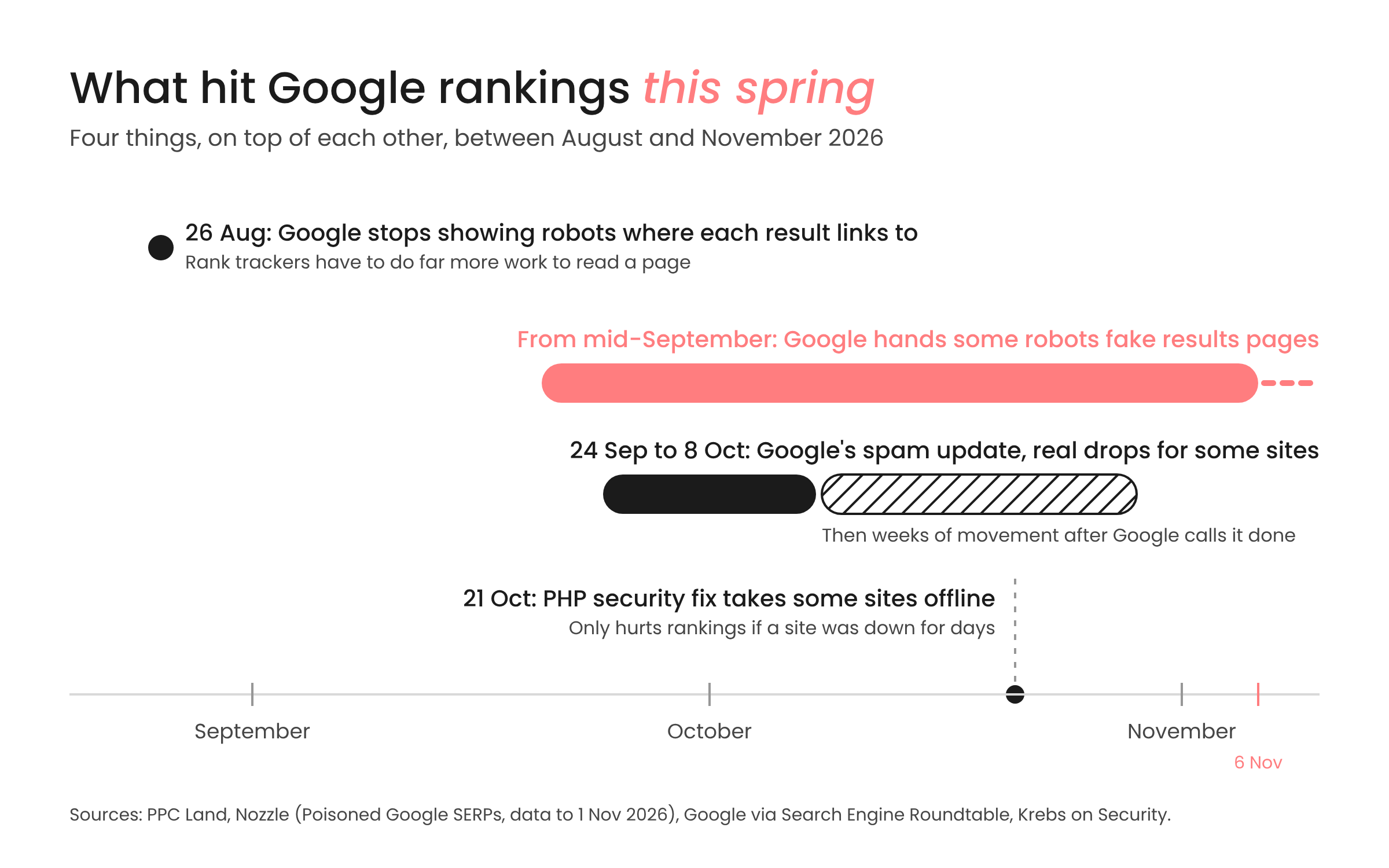
A rank tracker works by sending a robot to Google every day to search your keywords and note where your site appears. AI companies send the same kind of robots to copy Google’s results in bulk for their own products, and Google has spent the past few months trying to shut them out. It can’t easily tell one robot from another, so the rank trackers are getting caught up in it.
In August, Google confirmed it was routing result links through google.com/goto addresses instead of showing where each result pointed. Trackers had to follow every link to see the destination, which made tracking slower and very expensive (it’s why a lot of them just show the top 20 by default now). PPC Land reported that most vendors had handled it within days.
The bigger problem came next. From mid-September, Google blocked tracker traffic far more aggressively. For some of the robots that got through, it didn’t block them at all. It handed back a page that looks exactly like normal Google results, but with the usual websites swapped for others, often Facebook, YouTube and Instagram. The robot can’t tell, so it records your site as gone, while a real customer searching at the same moment still sees you. The industry calls these ‘poisoned SERPs’. Nozzle, a rank tracking company that publishes its data and method, checked over 40 million results pages. Between 13 September and 1 November, 14.3% of the results pages it collected had a swapped page one, against 0.17% before. For searches in Australia it was 21.1%. On a swapped page, the tracked website was missing from the top 10 63.5% of the time, against 2.6% normally.
In a rank tracker, that shows up as your site dropping off page one overnight, then coming back days later. Nozzle found 90.4% of swapped pages had their usual sites back within two weeks.
What the rank trackers said
Every major tool has now said something about it:
- Semrush: “We can confirm we’ve been seeing the ‘poisoned SERPs’ issue with Google returning inaccurate results since late summer.” (statement to Search Engine Roundtable)
- Ahrefs: “This is an industry-wide issue impacting many companies in our space. Depending on the data provider, we’re seeing between 5% and 20% of search results affected in this way.” (22 October)
- SE Ranking: “This can cause keywords to show false drops or appear as not ranking, even when their actual positions haven’t changed.” (16 October)
- AccuRanker: “A sudden ranking drop is not always a real change in your SEO performance.” (October)
- AgencyAnalytics: “Most rank tracking tools, including ours, are still affected.” (3 November)
Google hasn’t commented on the swapped pages. The AI scraping explanation is how Search Engine Roundtable and several of the vendors read it.
Not every drop this spring was fake
Some of the movement was real, which is what makes this period annoying to read. Google’s September spam update ran from 24 September to 8 October, starting the same day the swapped pages took off, and it will have caused real drops for some sites. Rankings rarely settle the day Google says an update is done, either. They keep moving for weeks, so we don’t put much weight on rank data straight after a big change. Search Engine Roundtable also reported unconfirmed ranking volatility on 20 and 21 October, again on 24 October and again on 27 October. Google hasn’t confirmed an update for any of those dates, and we’d treat the late-October readings with caution. Volatility trackers draw on the same kind of scraped results, and Nozzle’s swapped-page rate climbed sharply from 21 October.
Then there was PHP. On 21 October, PHP released emergency fixes for two critical security flaws. Krebs on Security put the share of websites needing the update at nearly 70%, WordPress sites included, and plenty of sites were taken offline while they were patched.
A short outage handled properly won’t cost you rankings. Google’s advice at the time was to serve a 503 status code, which it says “ensures already indexed URLs are preserved in Search while you work.” Its crawling documentation warns against doing that for longer than a day or two, because URLs that keep returning errors for several days can drop out of the index. If your site was down for days, or came back showing error pages, check those pages in Search Console. If it stayed up, PHP isn’t why your report looks odd. We haven’t seen any data showing the fix moved rankings broadly. It just landed in an already shaky week.
If you’re not sure whether your site has been patched, ask your host. If we look after your website hosting, ask us.
Will rank tracking settle down?
Not yet, no. Google is swapping more results now than it was at the start. Nozzle’s page-one rate eased in mid-October, then climbed to 34.8% on 27 October, above the September peak. AccuRanker recorded Google tightening its detection three more times in October.
What has improved is how well the tools catch it. Most now check results before storing them, fetch anything suspicious a second time and strip false drops out of past data. AccuRanker says stricter checks brought the swapped share in its stored data under 1% from mid-October, with one-day spikes after each Google change. Ahrefs says it’s cleaning up historic data. AgencyAnalytics, the reporting platform we use, has removed every recorded drop between 24 September and 1 November from its reports. It still says most tools, its own included, are affected, and asks users to treat any sudden drop as unconfirmed until a second check backs it up.
Nobody, Google included, has said how long this will go on. So read rankings as a trend over weeks, never as a single day’s number, and don’t hold your reporting hostage to the tools getting back to normal.
How to check your SEO results in Search Console
You don’t need to put your head in the sand this month though, Search Console is your best friend for the time being. Search Console is Google’s own record of real searches, it shows how often your pages appeared, how often people clicked and roughly where they saw you. It counts real searches rather than automated checks, which is why Semrush, AccuRanker and AgencyAnalytics all point their users there when a drop looks odd.
Here’s the check we’d run for any page you’ve been working on:
- Open Search Console and go to Performance, then Search results.
- Set the date range to Compare. Use the last 28 days against the previous 28, or this month against the same month last year if your business is seasonal.
- Open the Pages tab and find the page the work was meant to lift, such as the service page or the blog post.
- Compare its impressions and clicks across the two periods.
- Click into the page, then open the Queries tab to see the searches it showed up for.
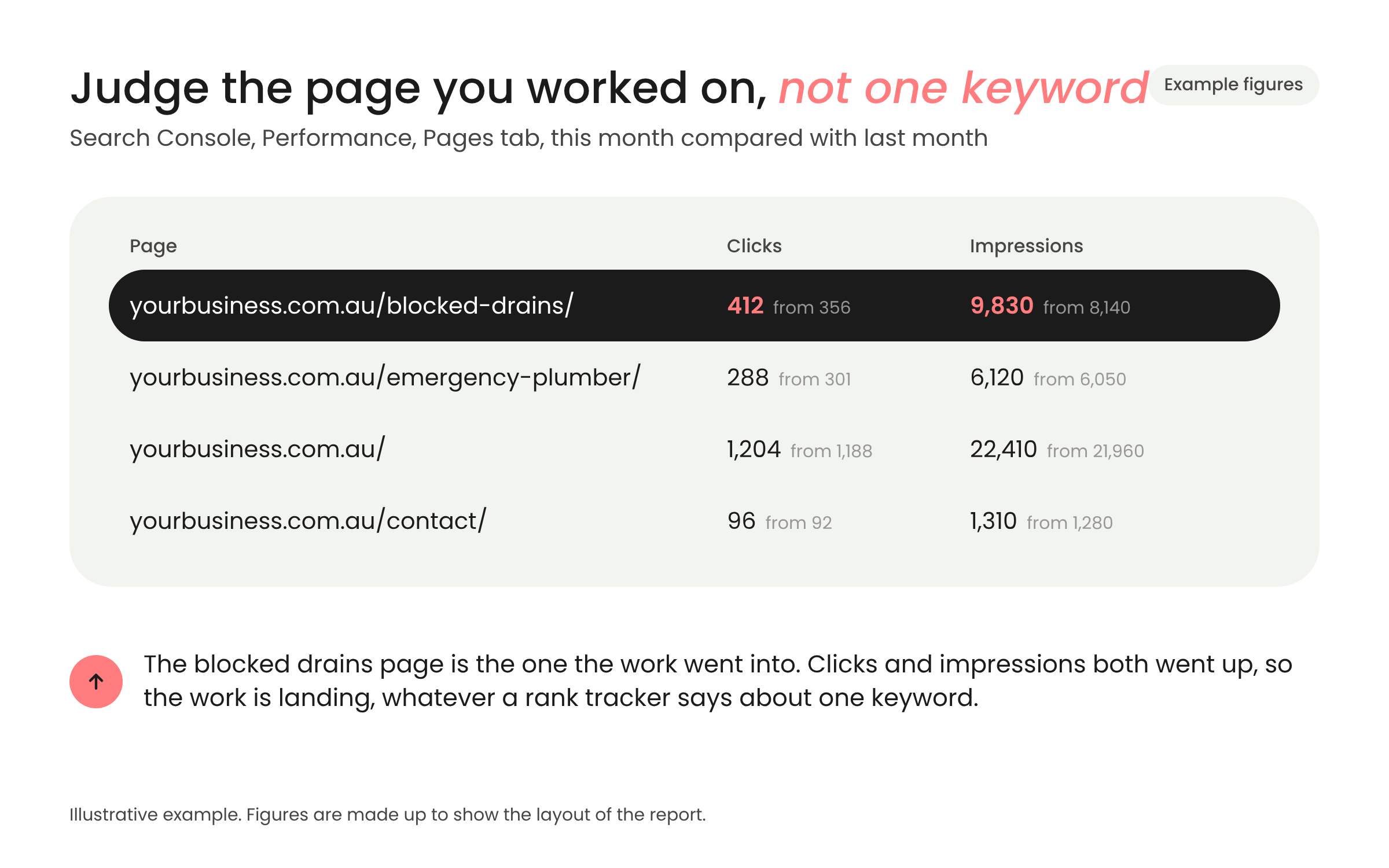
If impressions and clicks on that page went up, whatever you’re doing is working or whatever your competitors are doing is hurting them, no matter what the rank tracker says about one keyword. If both fell, it’s worth a closer look, and the Queries tab will usually show which searches dropped away.
Keep average position out of the headline. It’s an average across every search and every person, so it shifts for reasons that have nothing to do with your SEO. Don’t try to settle it by Googling yourself either. Google’s own help page says your results are specific to “the time, place, device, and recent history of the person searching.”
If Search Console isn’t set up for your site, or you’re not sure which pages to look at, our SEO team can walk you through it.
Why the page beats the keyword, every time
This isn’t only a workaround for a bad couple of months. For a business, a keyword ranking was always a stand-in for the thing you care about which is whether the right people find your page and click through to you.
You can rank first for a keyword nobody searches and get nothing from it. Meanwhile, the page you’re improving shows up for dozens or hundreds of variations you’d never think to track. Ahrefs looked at 3 million searches. The average page ranking first also ranked in the top 10 for nearly 1,000 other keywords, and the median was about 400. That study is from 2017, but open the Queries tab for any decent service page and you’ll see the same pattern even more now that people are asking questions to AI as well. Track ten of those searches and you’re watching a sliver of what the page does.
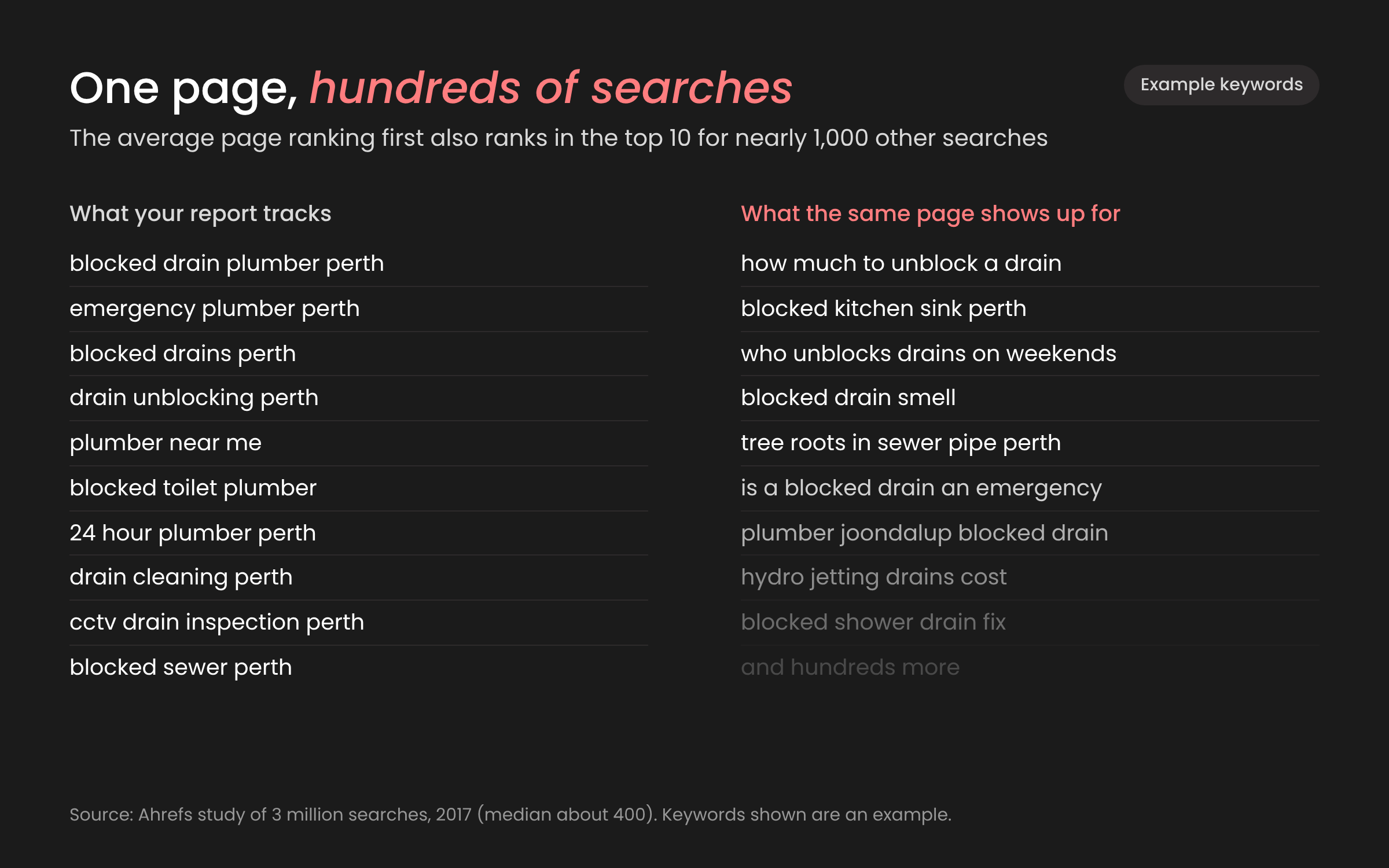
That’s why the question that matters for SEO results is whether the page you’re working on is being seen and clicked more by the people who’d buy from you. Search Console answers that cleanly.
One thing to watch for. With AI Overviews answering more searches on the results page, impressions can climb while clicks stay flat, because people get their answer without visiting. Read impressions and clicks together and if both go up, the page is doing its job. If impressions rise and clicks don’t, you’re visible but not getting the visit, and that’s a different situation that might be bad or expected if the search is a question. Our guide to the Search Console AI performance report covers that side.
What rankings are still good for
Rankings aren’t useless, they’re just the wrong scoreboard for a monthly verdict. They’re good for spotting a trend over months, seeing where competitors sit, doing keyword research and deciding which page to improve next and what it’s missing.
Where rankings fall down is answering “Did the work pay off?” and “Is our SEO worth what we’re spending?”. Those are business questions, and they need a page-level answer: more people seeing the page, more people clicking through, and ideally more of them getting in touch. Choosing the right keywords to aim a page at still matters.
Frequently asked questions
Did my site lose its Google rankings in October?
Probably not, if the drop hit lots of keywords on the same day and recovered within a few days. That’s the swapped-results pattern. Check the same pages in Search Console. If their impressions and clicks held steady, so did your visibility. If they fell between 24 September and 8 October, rule out Google’s spam update.
Is Search Console affected by the rank tracking problem?
Not as far as anyone has reported. Search Console counts real searches, not the automated checks Google is blocking. It isn’t perfect, because the newest data is preliminary and can change, and averages hide detail. Even so, it’s the most reliable record of how your pages are doing in Google right now.
Did the PHP security fix hurt my SEO?
Only if your site was down for days or showed error pages to Google. Google says a short outage that returns a 503 status code keeps your pages in its index. If you’re on WordPress and not sure your host has patched, ask them.
SEO reporting when rankings are wonky: what to do this month
Keep the rankings in the report, flag the tracking problem next to them, and lead with Search Console. For each page you worked on, show its impressions and clicks against last month or last year. That’s the honest version of the month, and it’s the version that still holds up next time rank tracking goes wonky.
If you’d like a hand reading your Search Console data, or want your SEO reporting built around your pages instead of a keyword list, talk to us. A real person on our SEO team will go through it with you.
How this post was made
This came out of the rank tracking problems showing up in client SEO reports in October 2026. AI tools gathered the published statements from the rank tracking companies, the news coverage and Google’s documentation, and helped draft from our notes. The angle, the Search Console method and the final call on what went in were ours. Every figure and quote was checked against the original sources: Nozzle’s Poisoned Google SERPs study (updated 1 November), the statements from Semrush, Ahrefs, SE Ranking, AccuRanker and AgencyAnalytics, Google’s Search Console Help and crawling documentation, and Krebs on Security. Written by Jack Headford and signed off by Rob Sharif.

Rob Sharif
Technical SEO Lead


